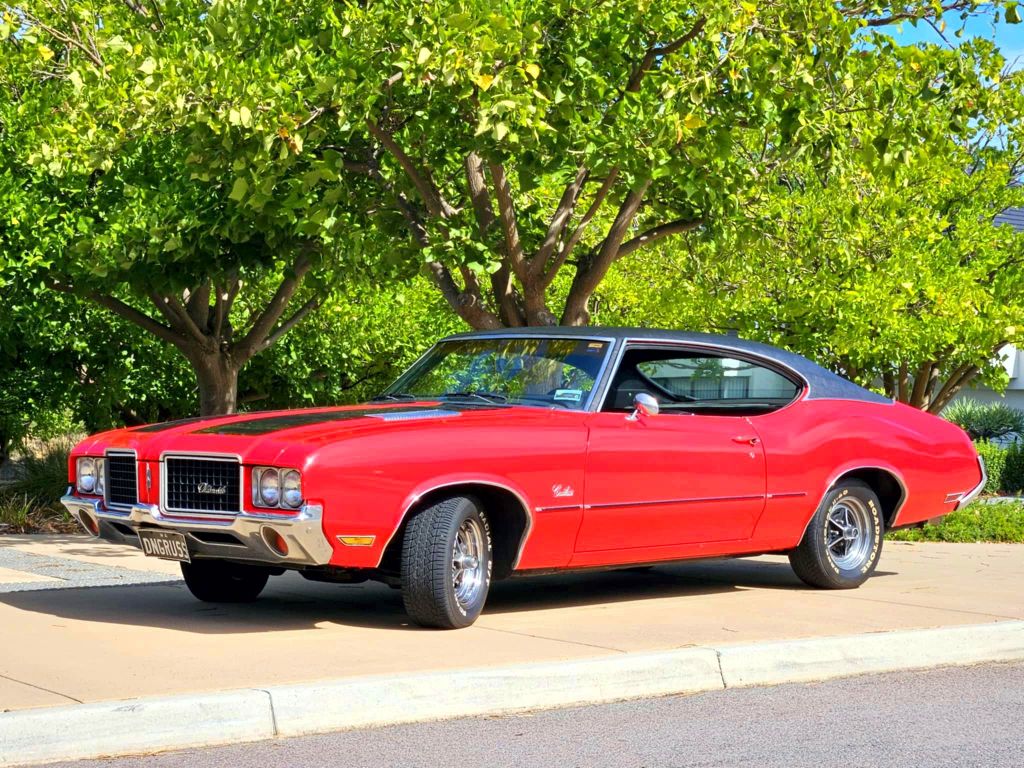
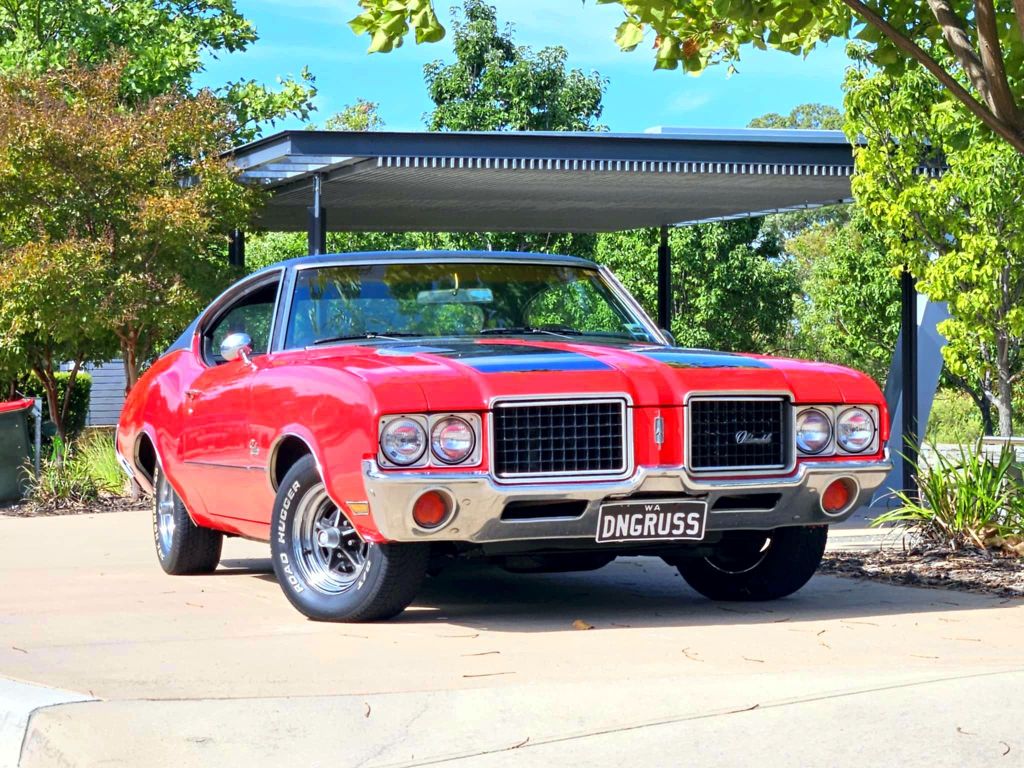
The name Cutlass comes from a curved slashing sword, once popular with pirates! This smart, bright red example is from the third generation of Cutlass.
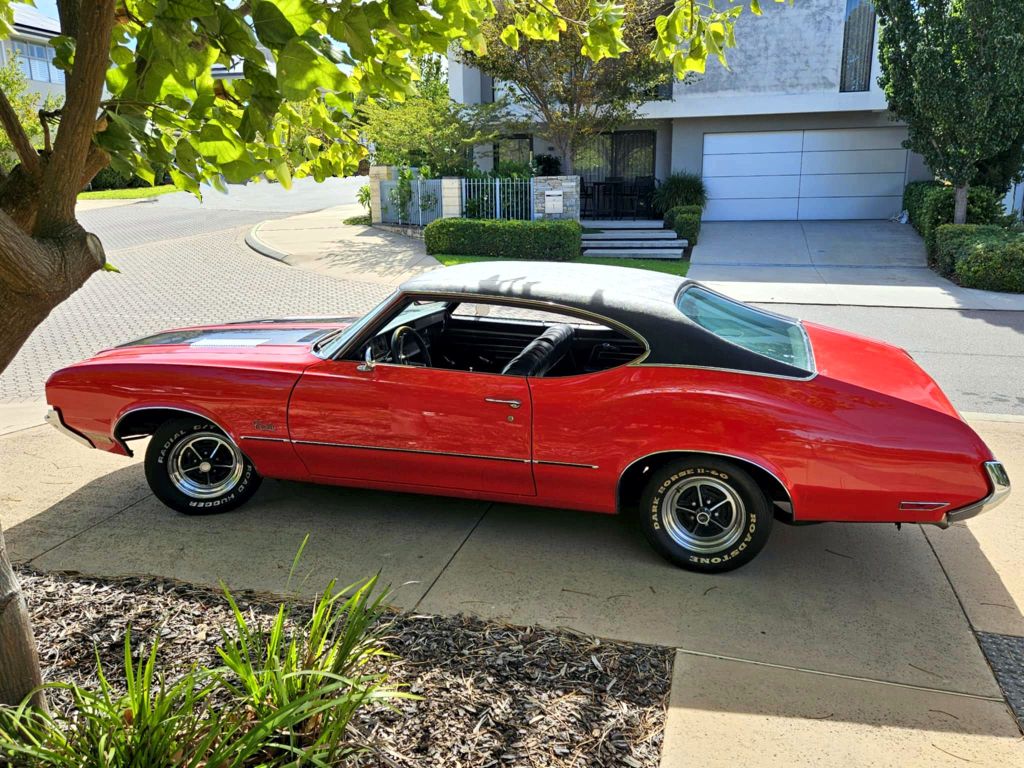
Fitted with one of the two V8 engine options, they offered great performance. This car has the 350cu-in (5.7-litre) V8 ‘Rocket’ engine and 3-speed automatic transmission. Fitments included the Oldsmobile Superstock wheels, vinyl roof, power steering and air conditioning (though the air conditioning has not been complete since before the present owner bought the car). This car also has the bonnet black-outs and matching black grilles giving it a very sporty look.
The current owner purchased the Cutlass ten years ago, the car having already been in Western Australia for a decade with its previous owner, who had imported the car. In 2014 he treated the car to an engine rebuild. It’s been a weekend car, and has proven very reliable which is no surprise for such a car, with only maintenance required, plus a new starter motor a few years ago. Tuning guru Bill Lee has serviced the car annually.
Aside from some minor wear and tear from age and use – nothing major – the only real fault is some rust bubbles showing at the bottom of the front wings, in an easy to repair spot. The panels and paintwork (redone by the previous owner) are all good. Underneath the car is dry and in very presentable condition – a sure sign of a sound car.
The car starts instantly on the turn of the key and idles nicely with a good burble to the exhaust. It’s clearly a well sorted car with a tight feel to it and the car drives well as a result.
This Cutlass makes a very interesting alternative to the common Mustang or Camaro, with its unique styling mixed with good performance. Parts availability is good from US specialist companies. Just 4339 of the V8 Coupe were built in 1971 – out of 769,000 Oldsmobiles built that year – so this is quite a rare car, and very attractively priced.
Whilst every effort to ensure accuracy is made when preparing the description of a car, much of the information is provided by the owner and cannot be guaranteed to be accurate and complete. Some errors and omissions occur occasionally and we cannot be held liable for any loss or damage arising from incorrect or incomplete information or any reliance which might be placed on information provided. Any potential purchaser is advised to make his or her own independent investigations or inspections to determine title and whether a vehicle is suitable for purchase.
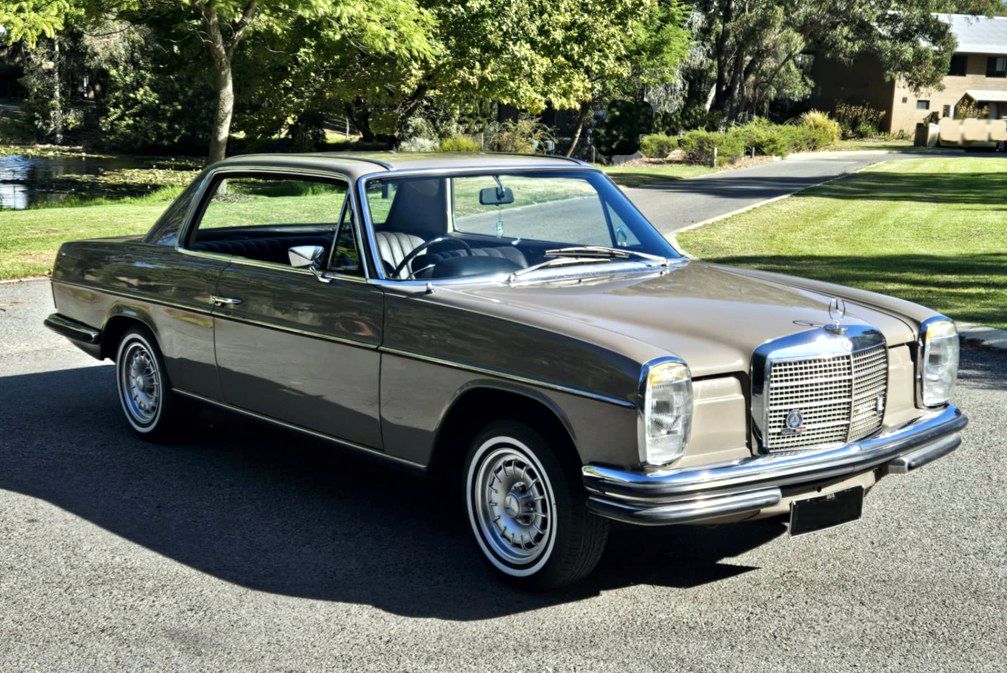
The first of the ‘Compact’ series was a tremendous success for Mercedes-Benz and after a couple of years the company offered a 2-door coupe version. Not just less and longer doors, the coupe featured a lower roofline, more angled front and rear windscreens and pillarless construction, giving the cars a very cool look for the period.
This car was delivered new in Perth on January 13 1970 by Diesel Motors. An expensive car at the time, the 250CE was priced at $9717, when a new Holden cost just one third of that amount.
The service book is stamped by Diesel Motors right through to 1984, from when another Mercedes-Benz dealership took over servicing duties. After filling the first book, a second one was issued which shows stamps up to 2011. A full set of books remains with the car.
Fitted with a set of genuine Mercedes-Benz Bundt alloy wheels, set-off with white sidewall tyres, the car presents very smartly.
Inside, the car has black MB-Tex upholstery with folding centre armrests front and rear, in excellent condition. Woodgrain on the dashboard adds some colour.
In the best, staid Mercedes-Benz manner, this 250CE drives nicely. It’s not a high performance car, but sits solidly on the road with good brakes and that great old Mercedes-Benz engineering which has ensured this car’s longevity. It’s definitely an attractive car which exudes a lot of old school cool…
If sold to a Western Australian buyer, the car will be registered by the seller upon sale.
Whilst every effort to ensure accuracy is made when preparing the description of a car, much of the information is provided by the owner and cannot be guaranteed to be accurate and complete. Some errors and omissions occur occasionally and we cannot be held liable for any loss or damage arising from incorrect or incomplete information or any reliance which might be placed on information provided. Any potential purchaser is advised to make his or her own independent investigations or inspections to determine title and whether a vehicle is suitable for purchase.
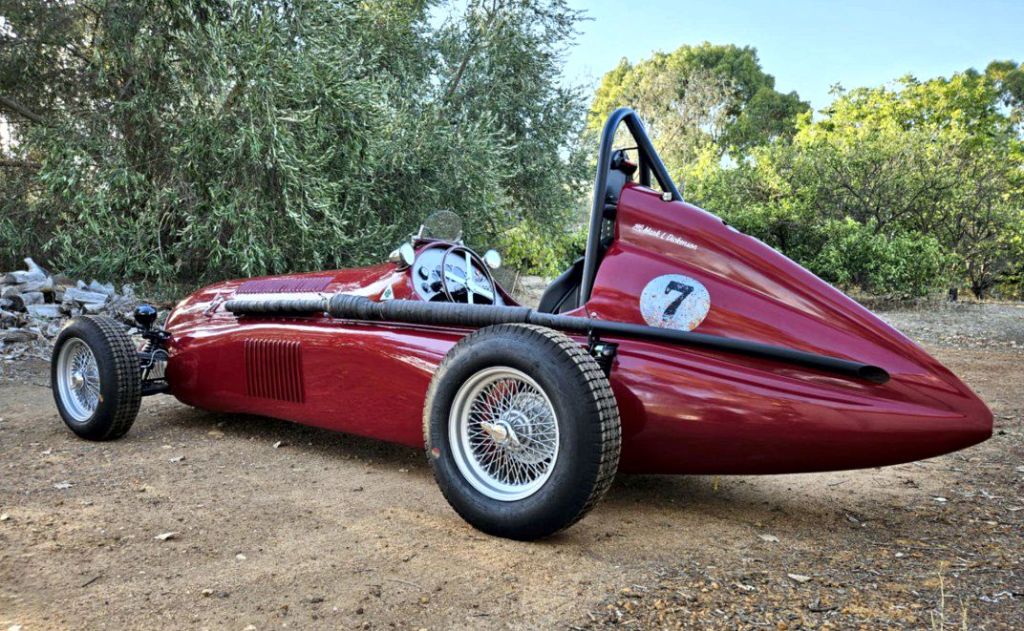
Here’s an amazing car. It’s not what it first seems… High profile British mechanic, creator and television presenter Ant Anstead is best known for his appearances in Master Mechanic and Wheeler Dealers shows.
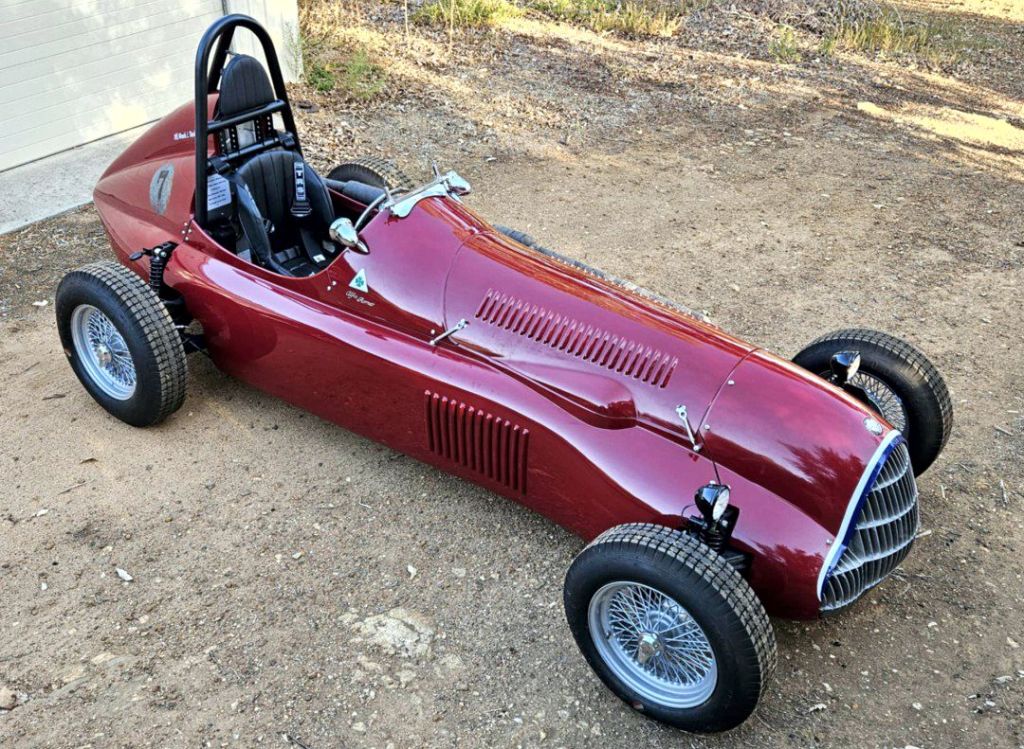
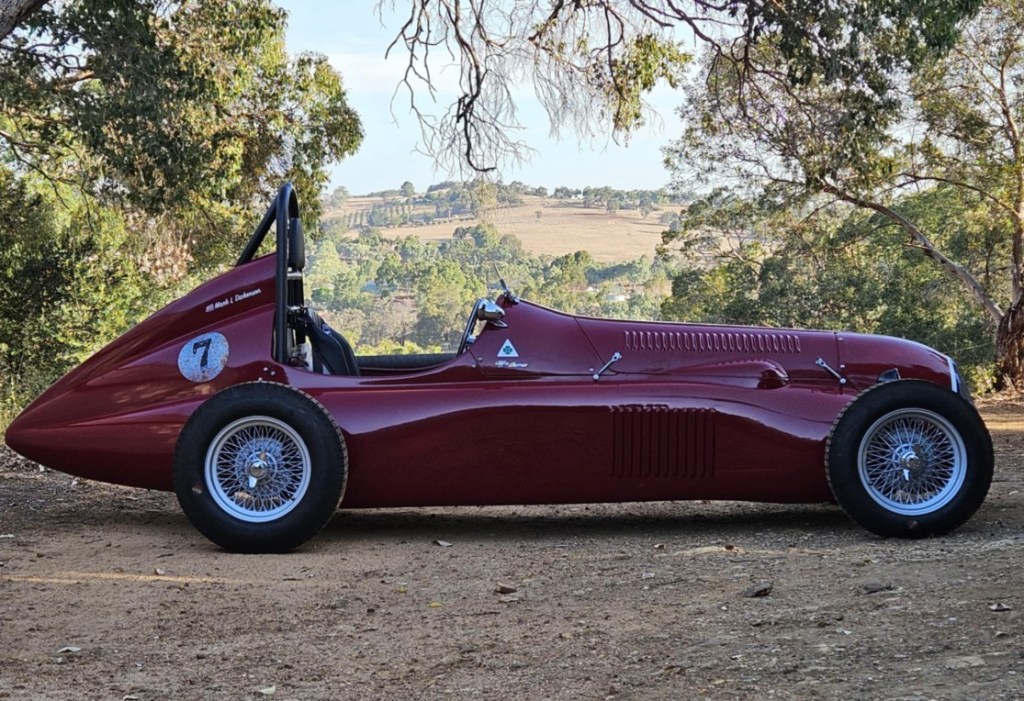
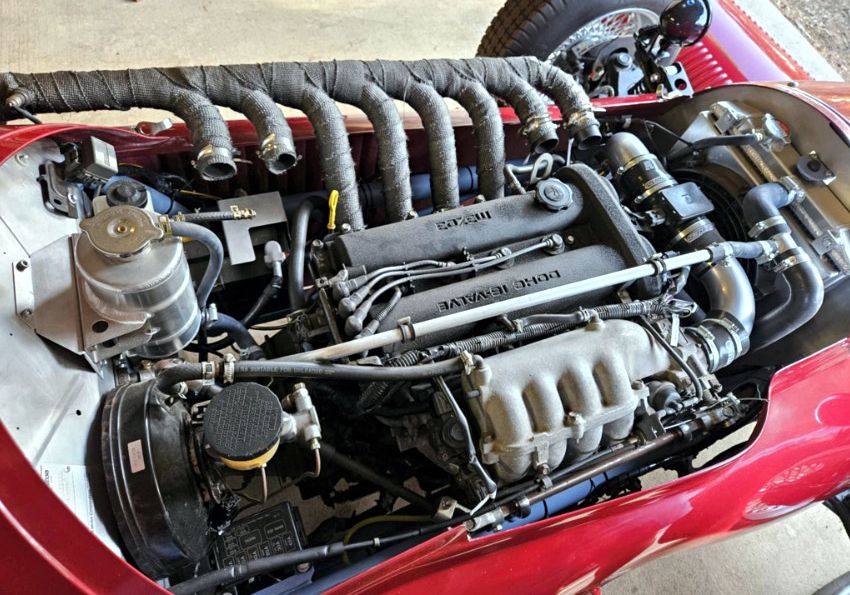
Anstead developed a car using proven modern mechanicals capturing the style and aura of the iconic prewar Alfa Romeo Grand Prix cars.
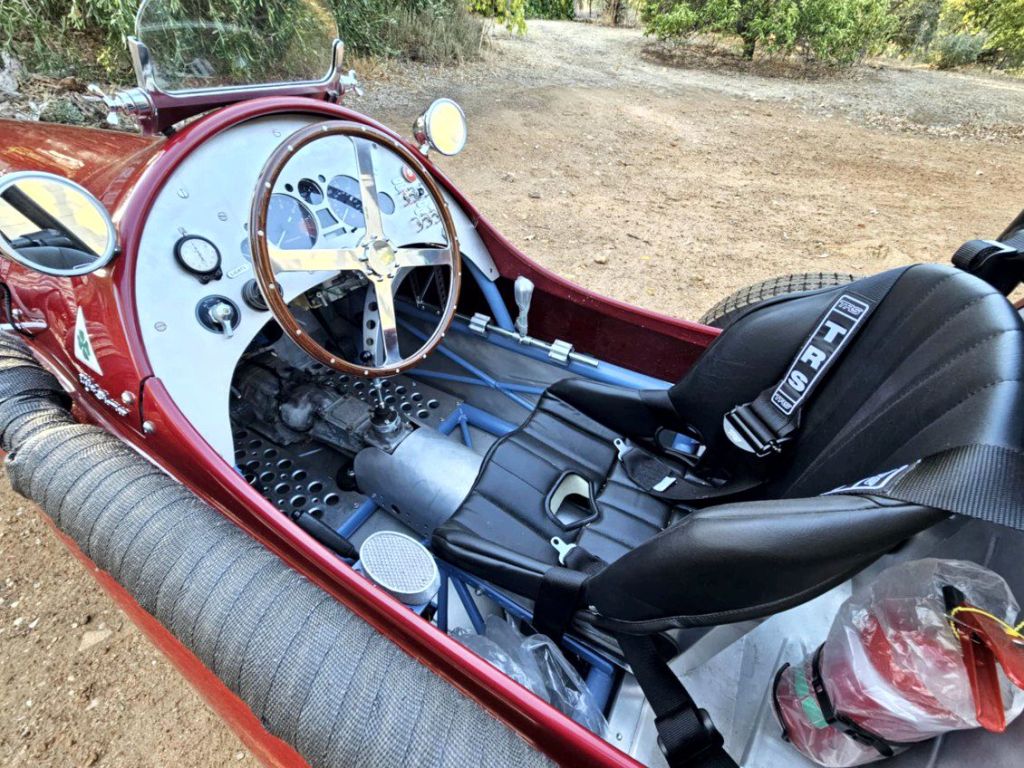
Put into production by Anstead’s Dowsett Cars available in a series of kits, designed around the running gear of a Mazda MX5, the Tipo 184 received rapturous reviews when announced.
It is a very thoroughly designed and developed design, with many clever and well thought out details and features.
In certain jurisdictions these can be registered. There are three in the Southern Hemisphere, and the one in New Zealand has been licensed. One in NSW has been built up as a competition car.
Purchased as a “Complete Package” with all new kits as detailed at Tipo184.com with the current cost of around $75,000 (plus shipping, GST and import duties). In addition to this a donor car is required. For the builder of this car, buying his brother’s low mileage MX5 NB.
For the experienced builder and restorer, this Tipo presented an exciting challenge – and the result is unquestionably impressive.
His original intention was to do hill climbs and Round the Houses events with the car, which has been finished to a very high standard. Given the change of circumstances of the owner’s ability to use the car, he is selling it in its finished, but not tested state. The car starts, runs very well and drives, but has not been taken to a track yet.
This is an exceptional opportunity for a car suited to club level motorsport, with proven mechanicals and thus low running costs, but with an iconic look from an era long ago.
Whilst every effort to ensure accuracy is made when preparing the description of a car, much of the information is provided by the owner and cannot be guaranteed to be accurate and complete. Some errors and omissions occur occasionally and we cannot be held liable for any loss or damage arising from incorrect or incomplete information or any reliance which might be placed on information provided. Any potential purchaser is advised to make his or her own independent investigations or inspections to determine title and whether a vehicle is suitable for purchase.
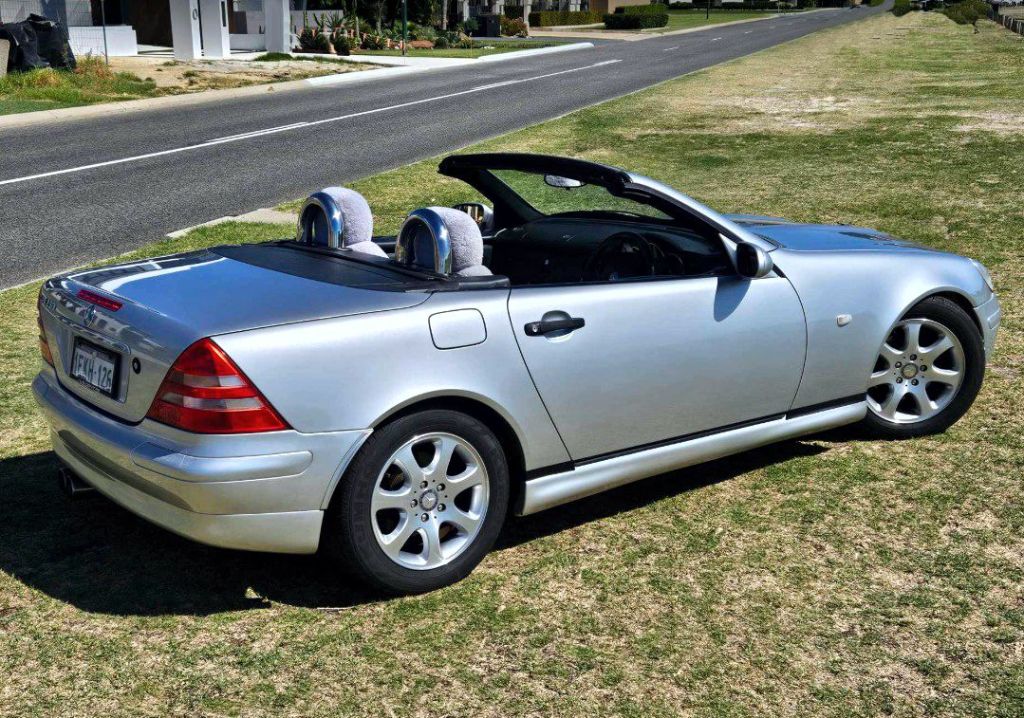
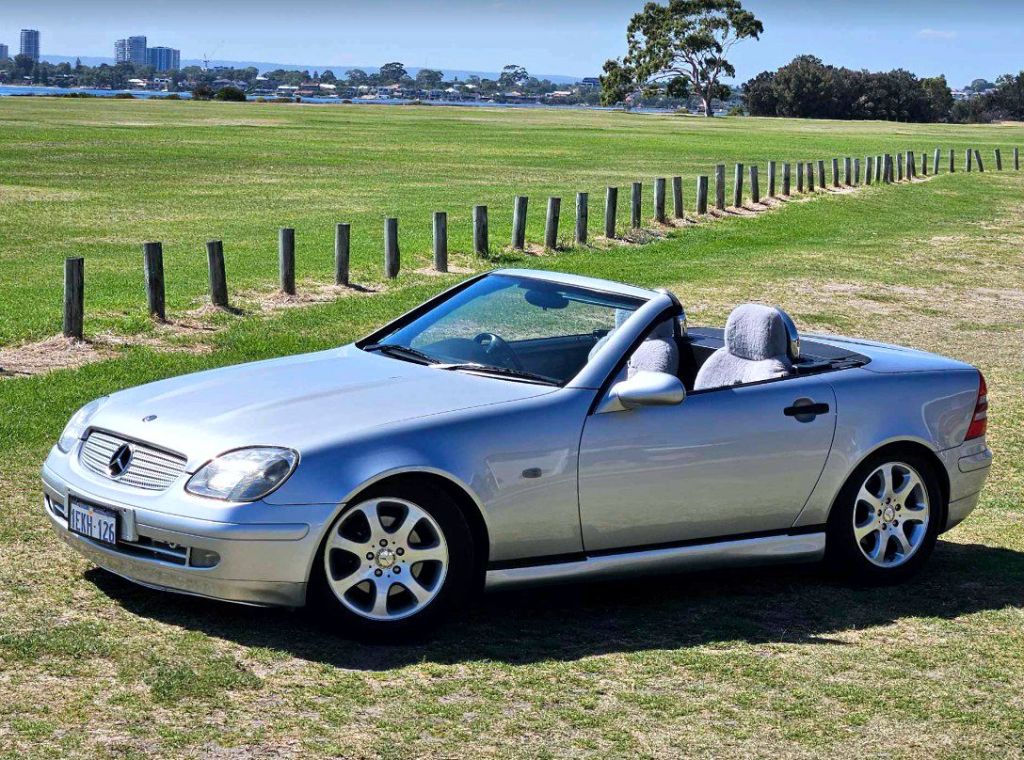
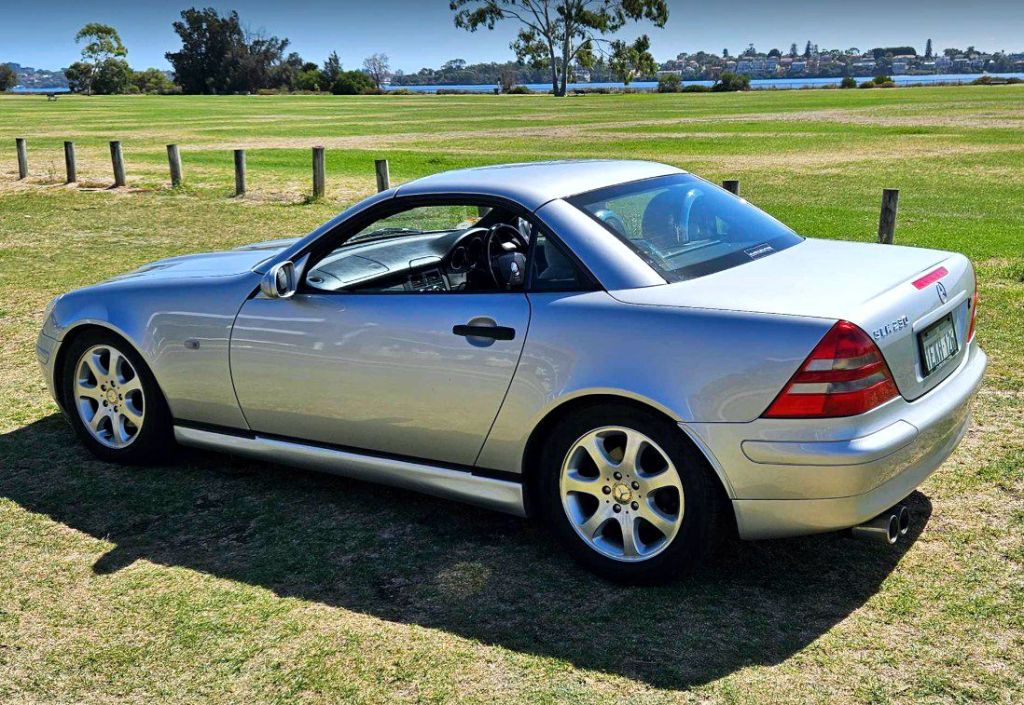
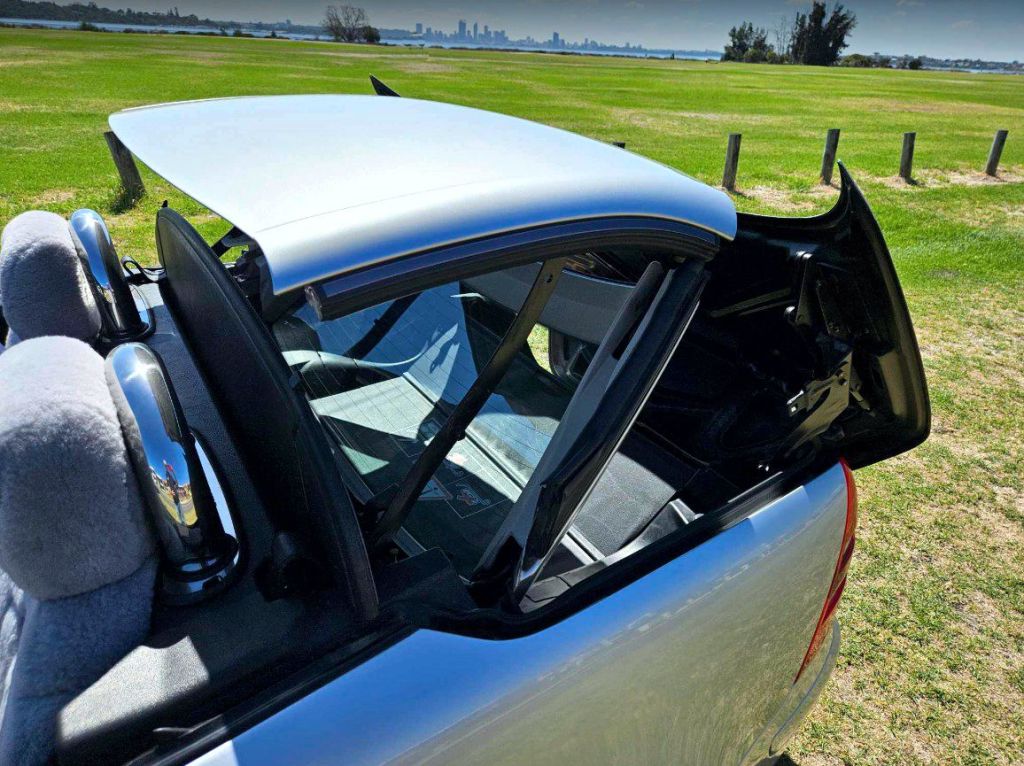
The SLK – a compact, luxurious sports model with folding hardtop roof and a perky supercharged engine was a formula for success.
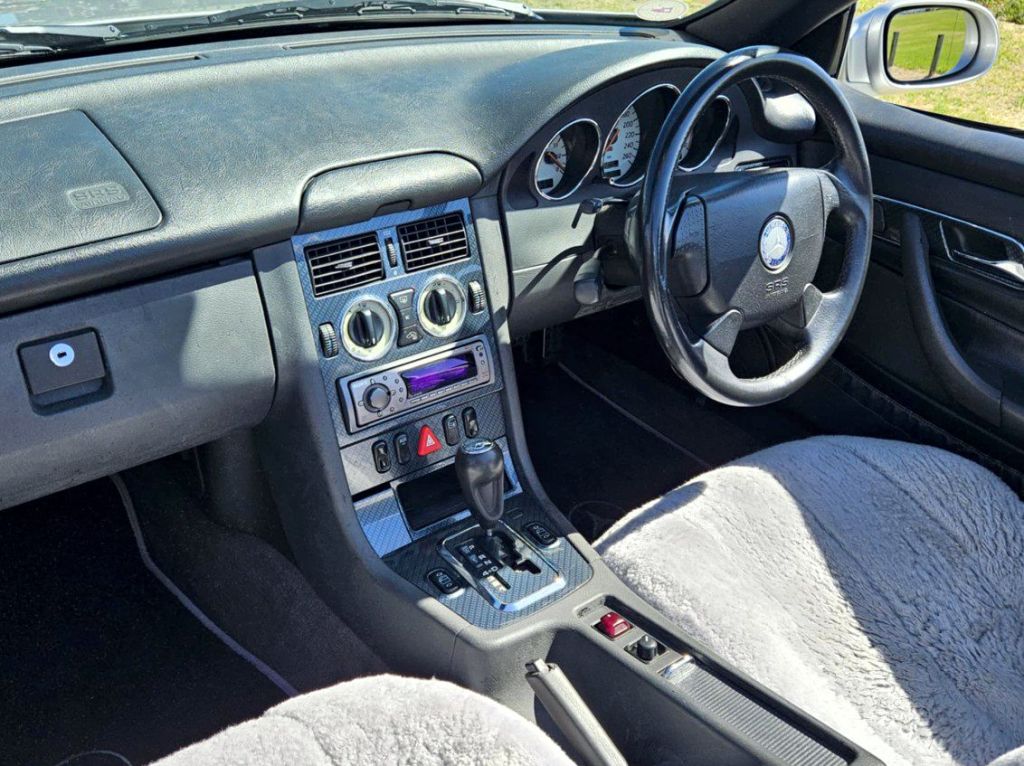
Standard equipment in Australia included leather upholstery, power windows, power steering, dual-zone climate control and alloy wheels. Safety features include front and side driver and passenger airbags, anti-lock brakes and electronic stability control.
In October 1997 this car was delivered new in Sydney and features the ‘sport package’ upgrades. This includes an optional design of alloy wheels, slightly lowered suspension, dual exhaust outlets, sideskirts and the lower section of the bumpers and grille colour-coded.
Ten years ago the owner purchased the SLK as an ‘extra’ car for weekend open-top motoring, to go with his vintage MG. The SLK saw little use in his decade of ownership and today the odometer reading is 128,000km. I sold the car recently and the new owner has since found a unique SLK with just a few hundred km on it from new. Hence this car’s back on the market.
The car starts instantly, runs smoothly and is completely easy to drive. The owner assures that everything works as it should.
These SLKs enjoy Mercedes-Benz quality and luxury and this two-seater sports model ads a lot of fun to the equation. This is a good, straight, well-presented example in above average condition. Unbeatable value…
Please request an email with more detailed information and a set of photographs, from paul@classicrally.com.au
Whilst every effort to ensure accuracy is made when preparing the description of a car, much of the information is provided by the owner and cannot be guaranteed to be accurate and complete. Some errors and omissions occur occasionally and we cannot be held liable for any loss or damage arising from incorrect or incomplete information or any reliance which might be placed on information provided. Any potential purchaser is advised to make his or her own independent investigations or inspections to determine title and whether a vehicle is suitable for purchase. MD28143
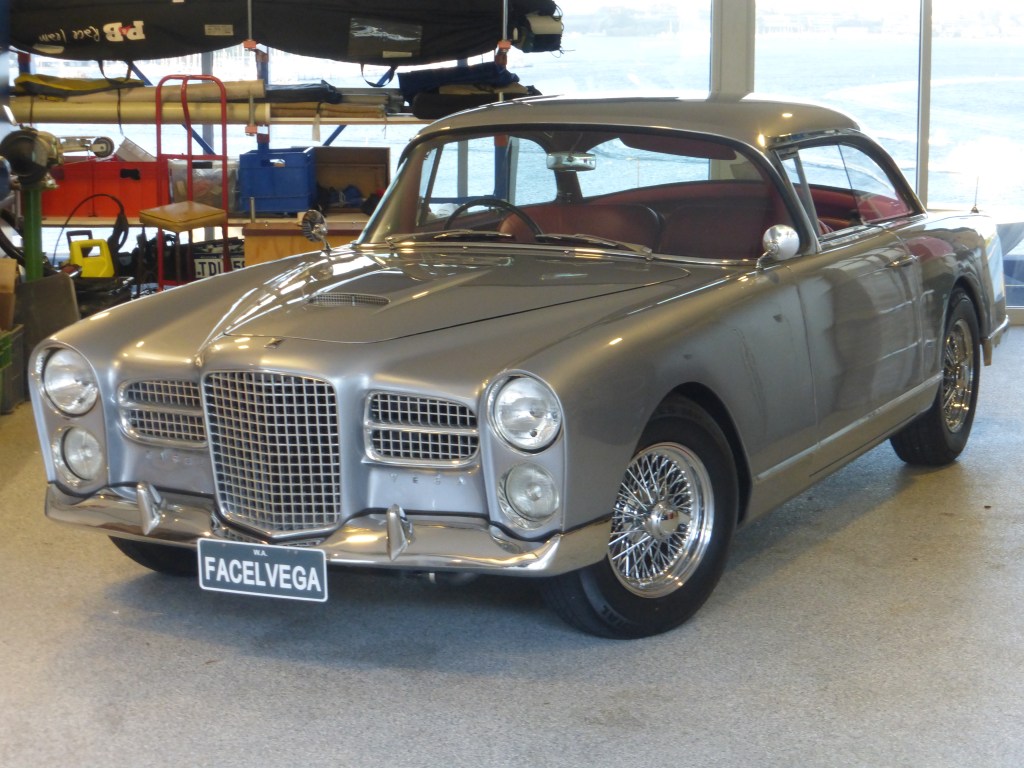
Facel Vega was a prestigious marque which flourished for just ten years. It was the product of a Paris-based company which had specialised in steel and stainless steel products. His company expanded to production of sporting versions for Simca and Ford, designed by Facel.
Jean Daninos, the company owner, bemoaned the fact that no French car maker produced exclusive vehicles. Great marques such as Bugatti, Delahaye and Delage had not survived for long after World War Two and registration costs of large-engined cars were prohibitive in France. His first efforts at extremely upmarket cars were based on Bentley chassis, of which just a handful were made.
By 1954 he had announced the Facel Vega, an exotic looking grand touring car boasting an American Chrysler V8 engine. Expensive, exclusive and stylish, the cars were a success from the start. Exports were strong and the cars appealed to the glitterati.
Over the next few years the model was developed further, with bigger engines and refined styling, becoming the HK500 in 1959, sporting a 6.3-litre V8 engine with 360 horsepower – and providing huge performance.
By now the Facel Vega was as fast as a Ferrari, and as expensive as a Rolls-Royce.
It was a very luxurious car for the late 1950s – with power steering, electric windows and leather seats. In that era a Rolls-Royce still had manual windows… Disc brakes and either a Pont-a-Mousson manual gearbox or Chrysler Torqueflite automatic transmission could be specified. Wire wheels were a popular option.
The company’s experience with stainless steel saw them use the material for bumpers, window surrounds and other brightwork on their stylish cars.
The Facel Vega became a must-have for the influential and wealthy people and attracted many big name owners, including Tony Curtis, Frank Sinatra, Ringo Starr, Joan Collins, Dean Martin, Danny Kay, Ava Gardner, Joan Fontaine, and many Barons, Counts, Lords, Princes, captains of industry and other very well-to-do buyers.
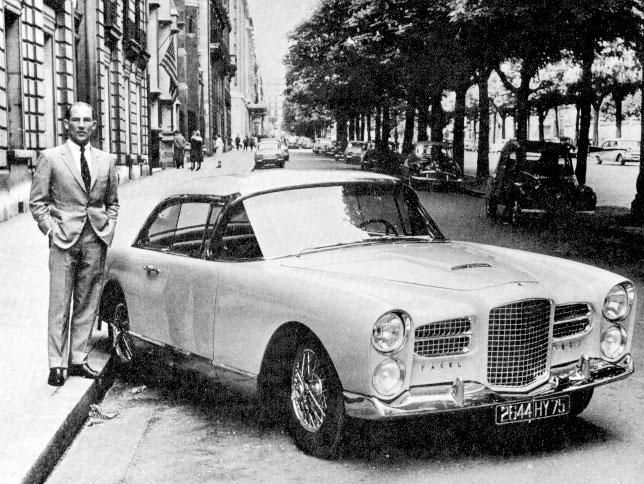
Famously, Stirling Moss was among several racing drivers to take delivery of Facel Vegas. The first time I met Sir Stirling, I asked him his recollections of the Facel. He told me that he used to change cars quite frequently, but kept the Facel Vega for a long time “because it was perfect for driving between races anywhere on the Continent”. A better recommendation would be unlikely.
In ten years of production, Facel Vega produced an interesting range of cars. Their staple product was the big V8-engined Grand Routiers, the FVS, HK500 and Facel 2 – each being a derivation of its predecessor, but with major changes along the way. Production numbers were always quite small.
The company made two cars which might be called aberrations with the benefit of hindsight. First was the Excellence – which was based on the HK500, with four doors, on a longer wheelbase and with a different rear end design. As a super luxurious, high performance sedan, it was unmatched. However, Facel made the Excellence with rear-hinged back doors and no central pillar, which was very dramatic, but did little for the structural integrity of the car.
Their next problem child was the Facellia. The decision was made to produce a smaller sports car, in much bigger quantities which would bring significant profits. The Facellia was a little larger than an MGB, though built to a higher specification and sold at a higher price point. The engine was a sweet twin-cam design, made by Pont-a-Mousson. While sales initially flourished, unfortunately the engine was not properly developed when the Facellia was launched and it caused nightmares for the company – eventually forcing it to close.
Had the company kept to its upmarket models only, it may well have survived – but specialist companies like Jensen, Aston Martin, Maserati and so many other specialists have bounced from owner to owner, from financial ruin to barely surviving, perhaps the writing was on the wall for Facel Vega anyway.
Above: I photographed this immaculate Facel ll at the International Facel Vega meeting, Sinsheim, Germany.
Below: Interior of the HK500 featured painted faux wood finish on the dashboard.
Above: The pretty Facellia brought about the demise of the company. Photographed at Automedon, Paris.
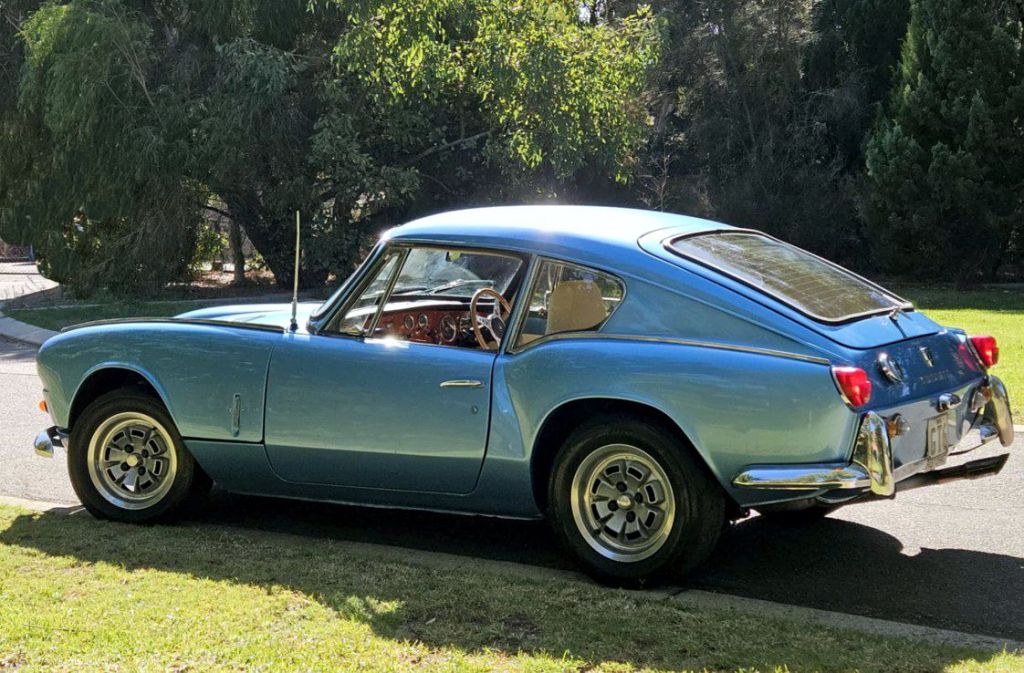
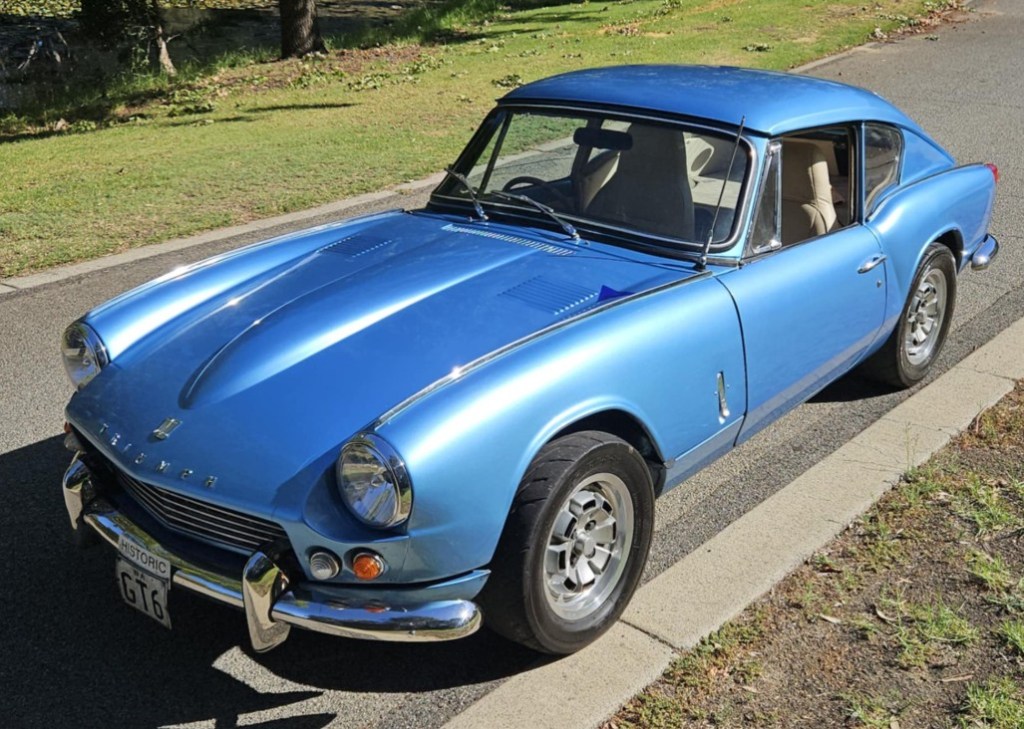
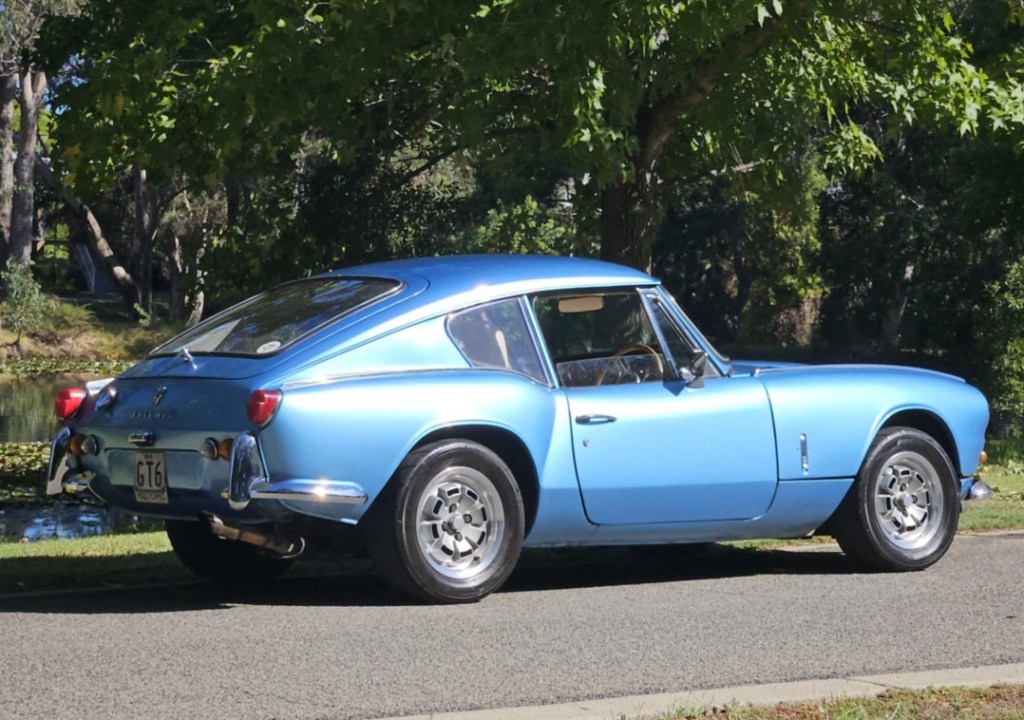
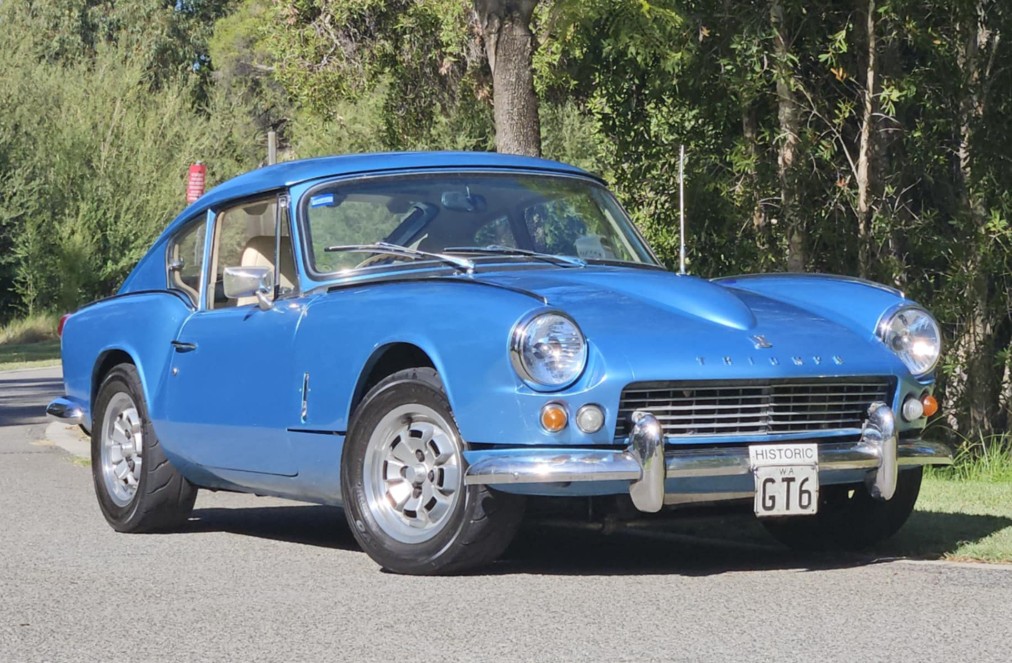
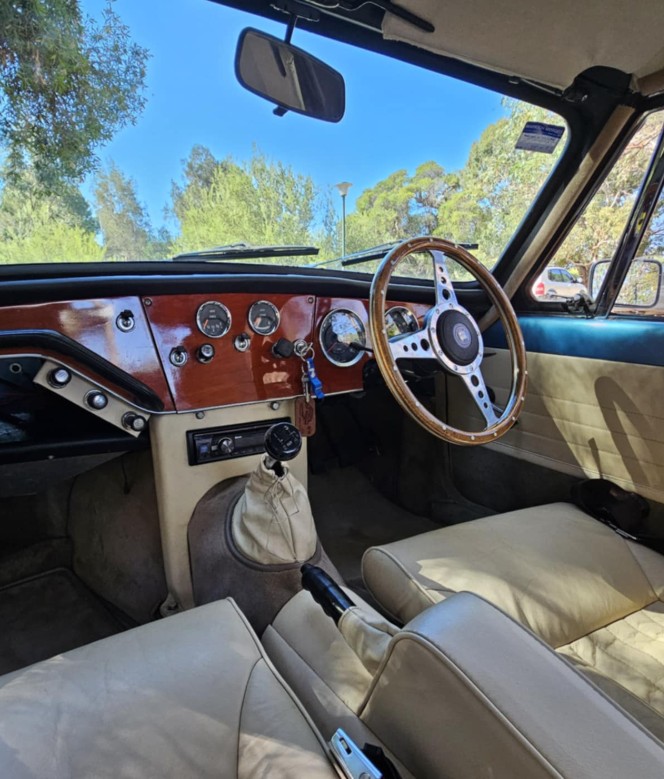
This car has been comprehensively rebuilt for multiple uses. As a country cruising car, as a competition car and as a club car.
Acquired by the current owner almost twenty years ago, a six year restoration was completed in 2012.
For the comfort angle, the car would be fitted with later type GT6 seats with headrests, trimmed in cream leather. The rest of the interior was trimmed and carpeted to match, with “Jaguar” carpets. Beneath is sound deadening material.
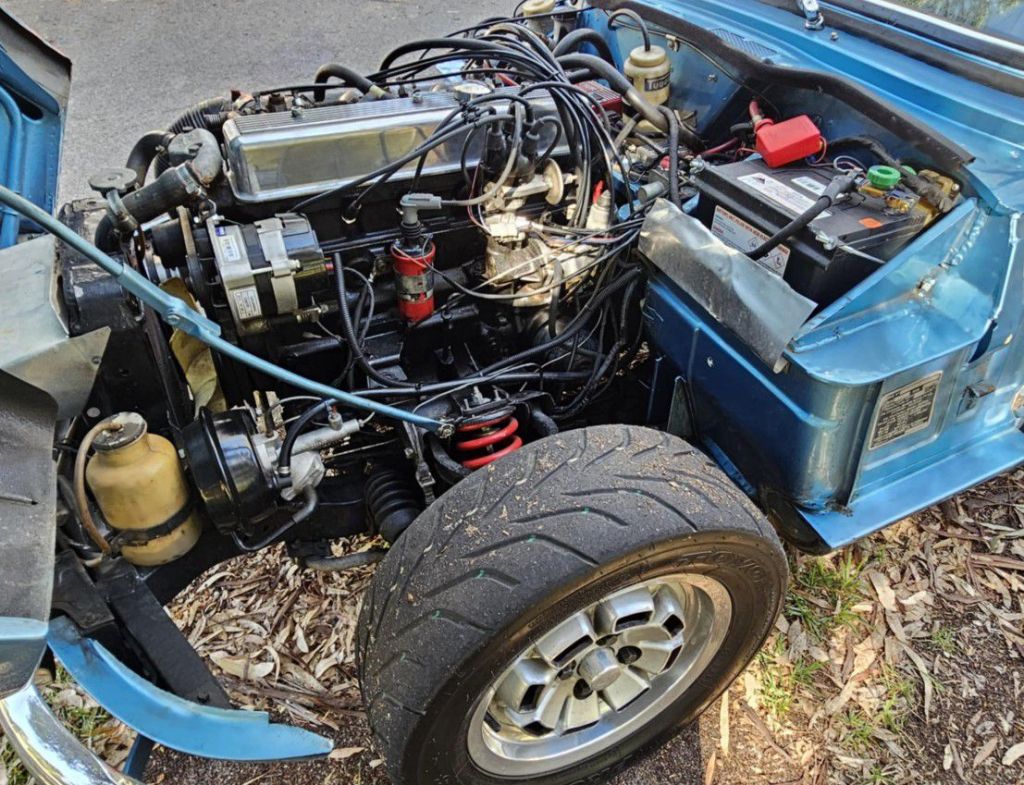
The owner’s intention was to create a car his wife could drive and which could also be used in club level motorsport events. Thus, a more powerful version of the Triumph 6-cylinder unit was built-up for the car. At 2.5 litres, with fuel injection the car’s power output is 130bhp. A stronger gearbox from a Triumph sedan is fitted, with electric overdrive.
Some $40,000 was spent on the build and when finished, the car began appearing at club events. At the Triumph Nationals, it was voted runner-up in the People’s Choice award. Upgrades to the suspension and brakes while refining the car for events saw an additional $12,000 spent.
The result is a potent, predictable sporty coupe which has competed in Albany Round the Houses events, track days at Wanneroo raceway with the VSCC and competed in motorkhanas with the Triumph club. The GT6 has attended Triumph Nationals in 2014, 2018 and 2024. It’s won several trophies…
There’s a Heritage Certificate with this car. The selling dealer was Premier Motors in Perth, WA state distributor for Triumph.
The rebuild was completed some years ago now and there’s the odd chip and blister, but overall it still presents very well. The GT6 drives very well, as one might expect after such a sorting campaign.
If the car sells to a Western Australian buyer the number plates GT6 will be available for $1000, otherwise standard issue plates will be provided.
The owner advises that the car has been very reliable and is keen to point out that it has no oil leaks and never runs hot. On the road it quickly becomes evident that while the car offers plenty of grunt, it can be docile and easy to use in traffic. It’s ready for use as a weekend fun car or in club motorsports.
Whilst every effort to ensure accuracy is made when preparing the description of a car, much of the information is provided by the owner and cannot be guaranteed to be accurate and complete. Some errors and omissions occur occasionally and we cannot be held liable for any loss or damage arising from incorrect or incomplete information or any reliance which might be placed on information provided. Any potential purchaser is advised to make his or her own independent investigations or inspections to determine title and whether a vehicle is suitable for purchase.
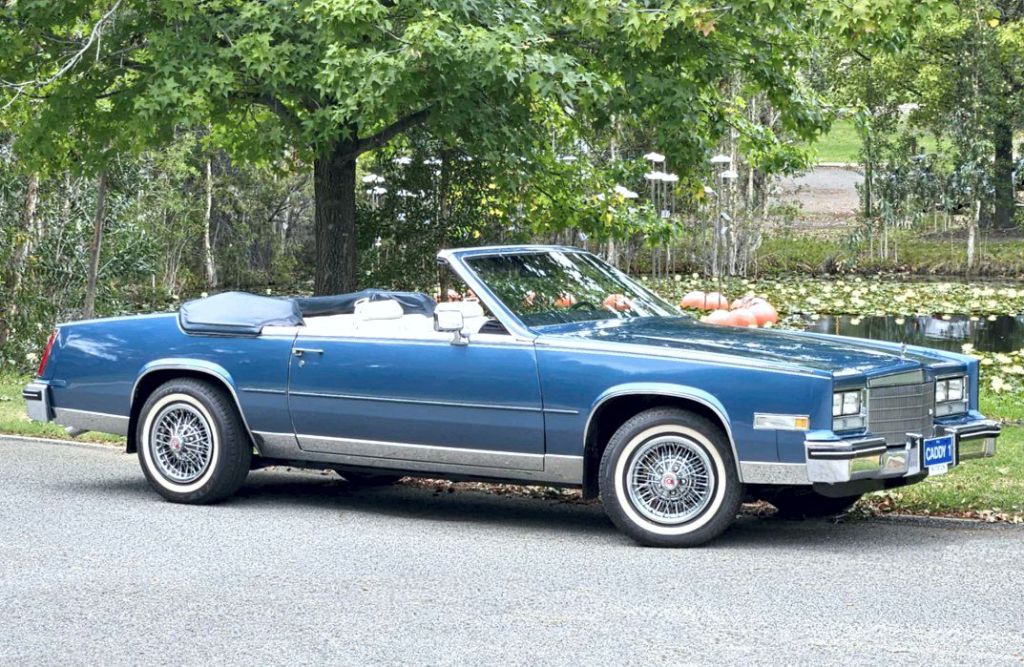
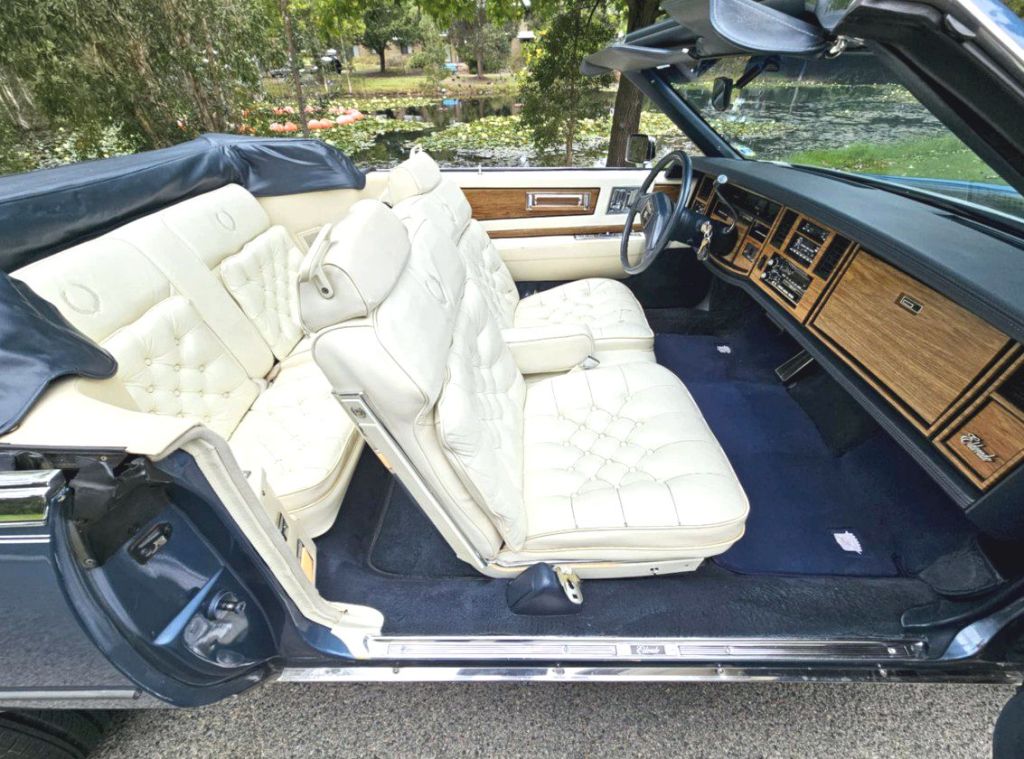
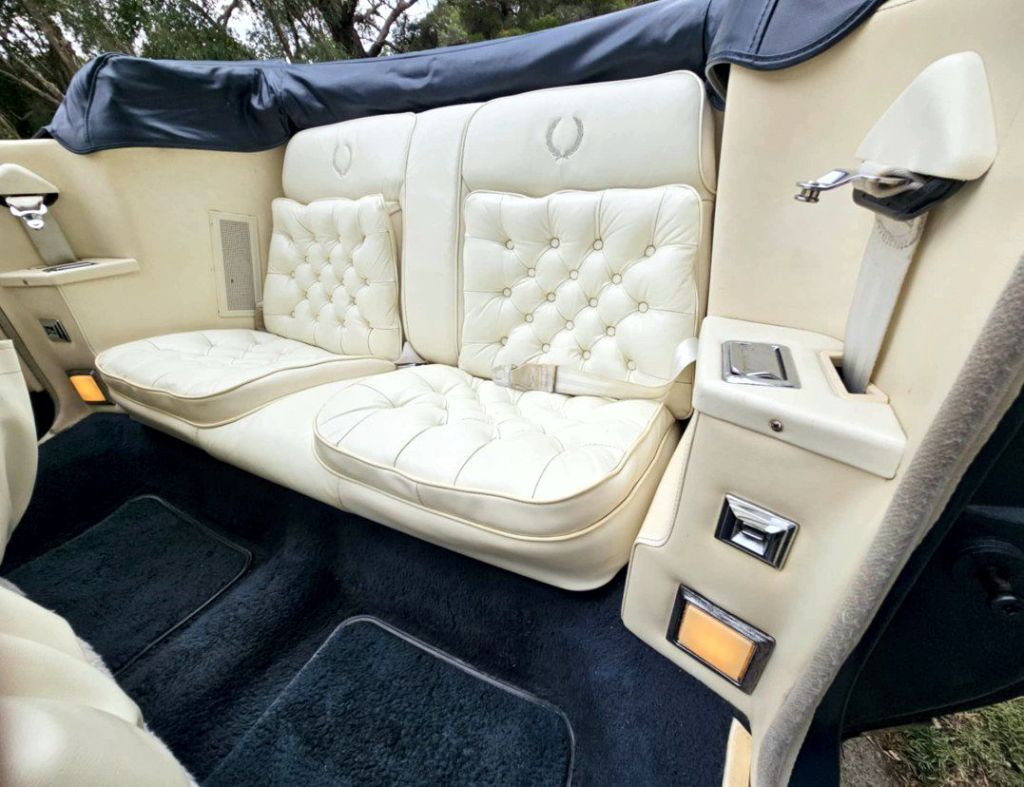
Cadillac’s top of the line model with convertible bodywork makes a big statement today, as it did when new. Extremely luxurious and well appointed, the Biarritz version was loaded with everything Cadillac could provide, from plush leather upholstery to self levelling rear suspension.
The motor is a 4.1-litre V8, tuned for economy and torque rather than outright performance.
This was the first American full-size car with fully independent suspension. Four-wheel disc brakes and an upgraded 4-speed automatic transmission helped keep the spec up to date.
Cadillac offered the Convertible (only in top spec Biarritz) for 1984 and 1985 only. Just 2300 were made in 1985.
Delivered new in Augusta, Georgia, USA on February 1 1985, the car was fitted with the desirable option are the chrome wire wheels, which suit the car well.
The Eldo was imported to Western Australia 15 years ago and changed hands two years later. The new owner was a Cadillac Club member. He took the car to club events and the 2014 Cadillac Nationals. It sold to another Cadillac Club member, two years ago. He has done some work to the car to bring it up to top condition. Details provided in full description.
The car was taken to the 2024 Cadillac Nationals in Busselton, where it performed faultlessly.
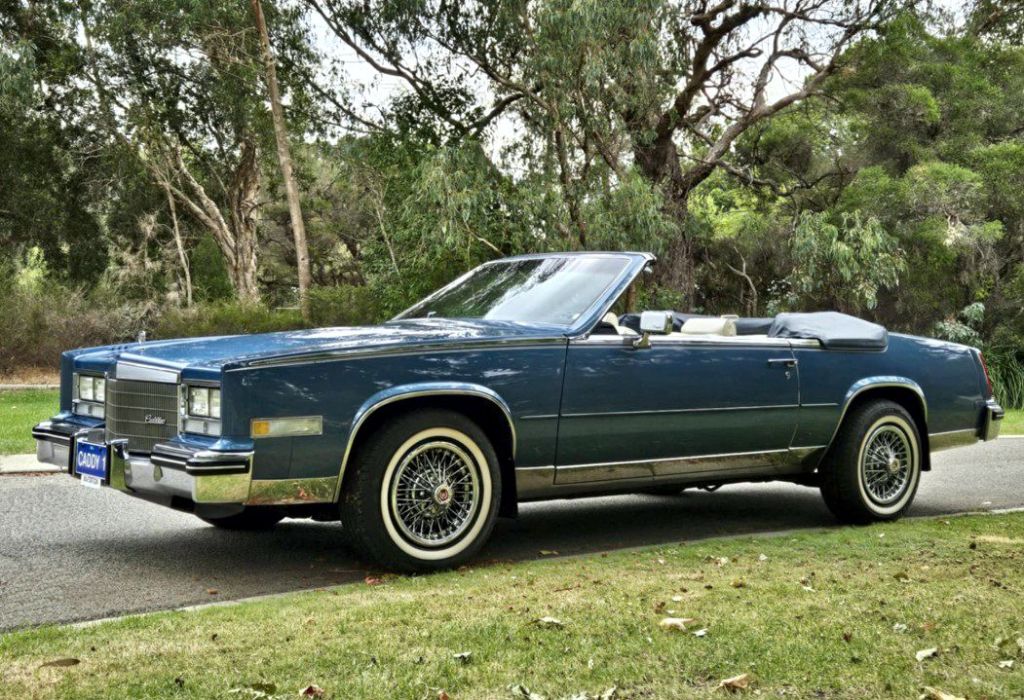
The condition of the car is very good inside and out. It’s all tidy and intact, showing the low mileage (78,000 miles) is accurate.
With the car are the original books compendium, Gold Key card, a factory-issued cassette of 1985 Cadillac information, a history file, two workshop manuals and other documentation specific to 1985 Eldorado. The car has two keys.
The number plates CADDY 1 go with the car if sold to a Western Australian buyer.
The colour scheme suits the car very well. Wherever the owner has displayed the Eldorado it has gained a lot of positive attention. Chances of finding such a good, original Convertible are slim in Australia.
Whilst every effort to ensure accuracy is made when preparing the description of a car, much of the information is provided by the owner and cannot be guaranteed to be accurate and complete. Some errors and omissions occur occasionally and we cannot be held liable for any loss or damage arising from incorrect or incomplete information or any reliance which might be placed on information provided. Any potential purchaser is advised to make his or her own independent investigations or inspections to determine title and whether a vehicle is suitable for purchase.
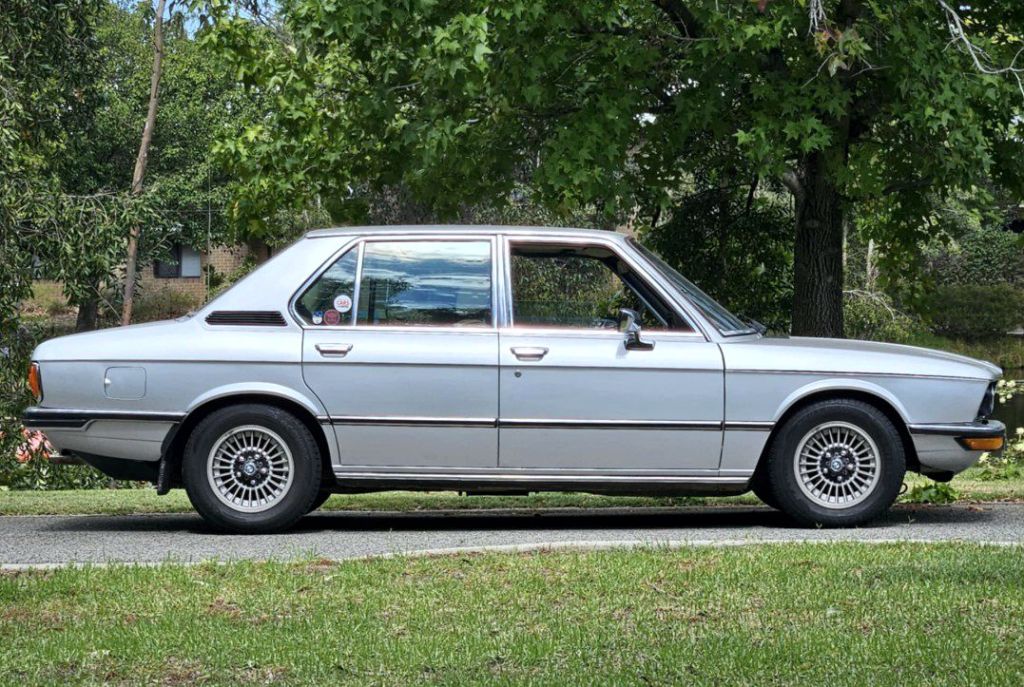
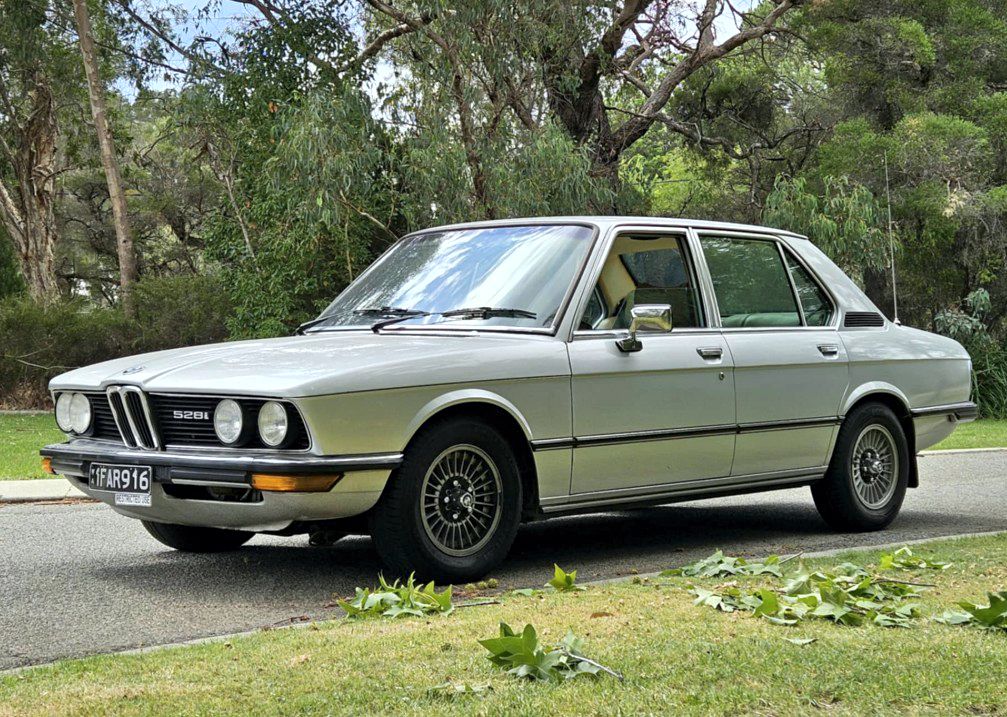
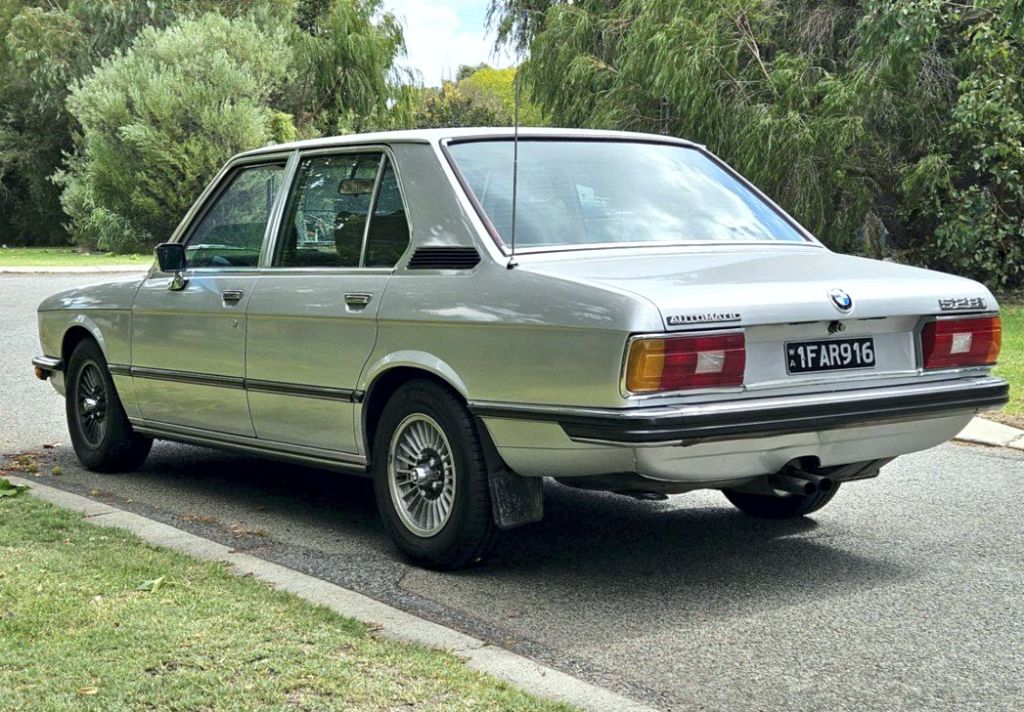
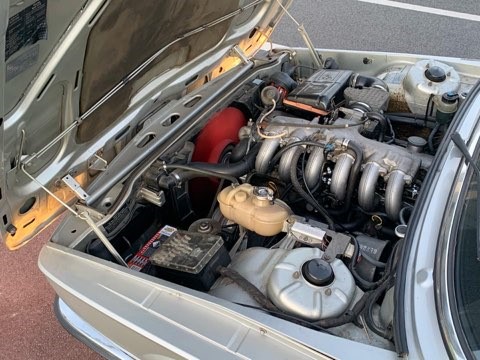
This car was the range-topping 528i model featuring the fuel injected 2.8-litre version of the company’s much admired straight six engine. This was the largest engine in the E12 marketed in Australia. The modern sports saloon had arrived – and changed the face of BMW in Australia.
This fine example was delivered new in December 1977 in Launceston to a local doctor. A comprehensive log of work was kept by the owner, still present in the service book. From these notes, it appears that the same owner retained the car right through to the year 2000, by which time the car had covered 200,000km. Today, the car has covered a low 210,800km, all of which explains the 528i’s impressive, original condition.
The previous owner purchased the car in Tasmania and shipped it to Perth having it recommissioned after arrival. There were no issues getting WA registration for the car.
He sold the car 5 years ago through this brokerage service to a collector who is now selling. The present owner has covered some 9000 enjoyable kilometres in the car, while it’s been one of several cars in his collection.
In his ownership, work undertaken saw some $6300 spent to ensure the car runs perfectly.
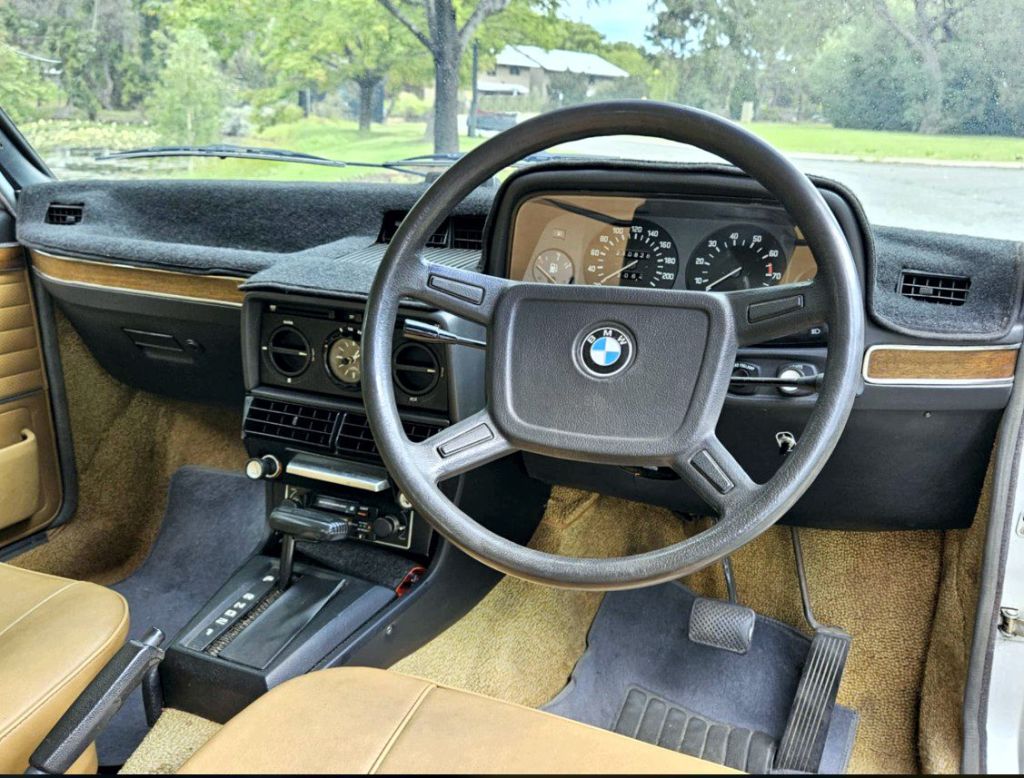
Finished in attractive Polaris silver metallic, it features multi-spoke alloy wheels, 4-wheel disc brakes, air conditioning and power steering.
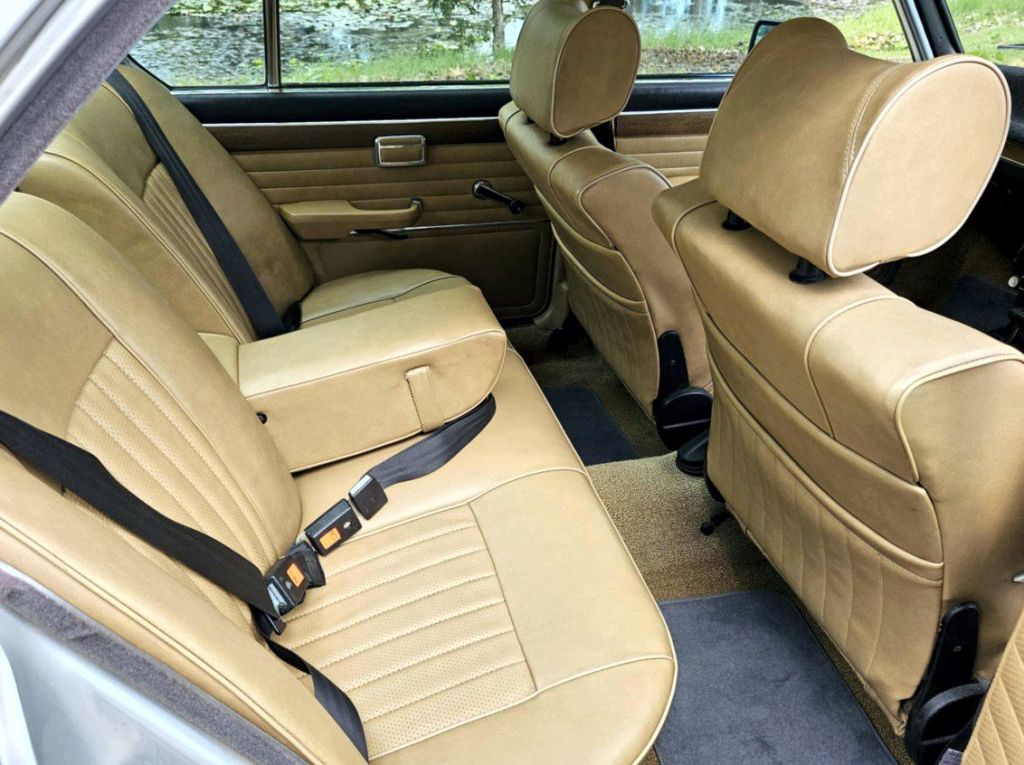
The car is in especially good, original condition and is a prime collector’s piece. The bodywork is straight and rust-free and the paint has an excellent shine to it. The external hardware, bumpers, lights, badges, etc are all excellent for their age, though a couple of small cosmetic items could benefit from attention.
The complete OEM tool kit inside the boot lid, etc, are all present, as is the complete original set of books. Currently on club license it can easily be changed to full license or transferred as is. Reg: 1FAR916
It is rare to see one of these cars that has been so well preserved – clearly it has always been cherished. This car would be one of the better examples in Australia.
Chances of finding such an original, correct E12 are slim, moreso for the desirable 528i version. Don’t miss your chance…
Please request an email with full details and more photographs from paul@classicrally.com.au
Paul Blank Classic Car Broker – MD28143
Whilst every effort to ensure accuracy is made when preparing the description of a car, much of the information is provided by the owner and cannot be guaranteed to be accurate and complete. Some errors and omissions occur occasionally and we cannot be held liable for any loss or damage arising from incorrect or incomplete information or any reliance which might be placed on information provided. Any potential purchaser is advised to make his or her own independent investigations or inspections to determine title and whether a vehicle is suitable for purchase
Three time Formula 1 World Champion and the only person to achieve a championship win in a car of his own construction. Twice I hosted Sir Jack when he was a star driver in the Classic Rally I ran in Western Australia. I got to know him then and in 2006 at the Classic Adelaide Rally, interviewed him for a magazine article.
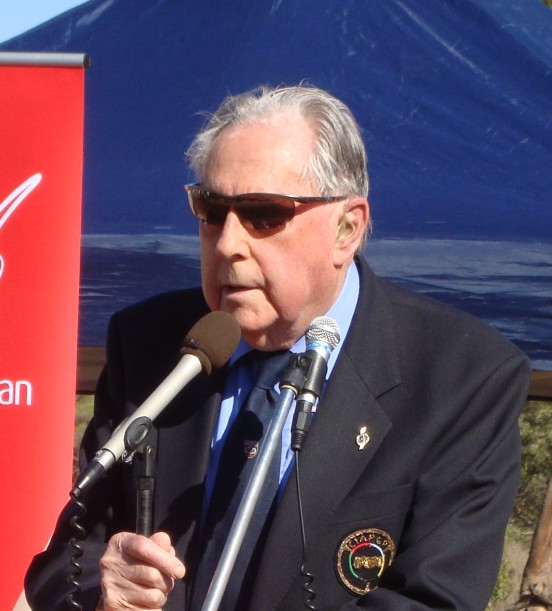
Above: Sir Jack aged 85 in 2011 at the old Caversham racetrack addresses the crowd at the naming ceremony for the suburb which would bear his name. Photo: Paul Blank
2006: He’s one of our nation’s greatest sporting heroes and a man whose achievements in motor racing are unequalled around the globe. But there’s a younger generation of Australians who might be familiar with the name, but don’t really know what Sir Jack Brabham is all about and why he should be so revered as such an all-time great.
Today he is eighty years old – and has long been the oldest living Grand Prix World Champion “I’m six months older than Phil Hill” the American World Champion from 1961, Sir Jack proudly pronounces. He’s from an era when driving a Grand Prix car was an extremely dangerous occupation – many of his contemporaries died while racing. And anyone reaching eighty today has made an achievement in that itself.
It was forty years ago that Jack Brabham won the last of his Formula 1 World Championship races.
Born into an everyday kind of Australian family, his racing began way back in 1948 when he took over a friend’s dirt track speedway car he’d helped build, and within a remarkably short space of time had become a winner. In fact, in his first season at the big Royale Speedway at the Sydney Showgrounds, he came away NSW Champion.
Throughout his racing career, Brabham’s keen engineering insight meant that he was often able to keep a car going when others’ would expire.
Speedway led to circuit racing and the odd hillclimb which took Brabham to other states in Australia to compete. In 1954 he was invited to his first overseas race at Ardmore near Auckland for the New Zealand Grand Prix. There he met for the first time a young Bruce McLaren, who would later race for Brabham and eventually become a race car maker himself. McLaren’s name lives on in race and road cars today.
After a string of successes down under, the call of Europe was too strong for Brabham to resist and in 1955 he took the plunge. He was a well enough respected driver to be racing an F1 car that same year.
Back to Australia for our summer saw him win the Australian Grand Prix, before heading to Europe for a second season. After a disastrous fling with an Italian mistress – a Maserati 250F – support by the Cooper team gave Brabham the fillip he needed for real success. This was a period where Cooper’s avant garde lightweight, mid-engine racers started to show promise against the big front-engined Grand Prix cars.
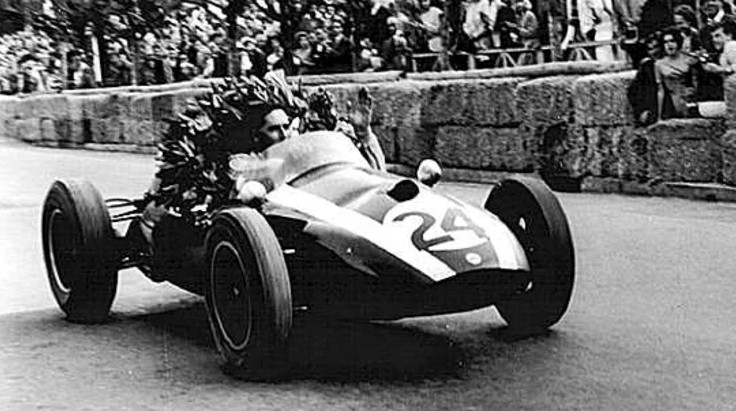
The first Grand Prix win came Brabham’s way in 1959 at Silverstone, followed by his first World Championship race win at Monaco – and what began as a trickle would become a torrent. Brabham was crowned World Champion at the finish of the 1959 season. The first ever Australian champion.
To emphasise his brilliance, Brabham backed up his success by taking away the 1960 World Championship as well.
The early 1960s saw Brabham develop his own cars, something which a small number of other drivers had done through the years. His engineering skills along with others, notably Ron Tauranac, produced some searingly effective cars.
He also ran the team of Brabham cars in Grands Prix. His company was becoming a very successful manufacturer and seller of its racing cars of various classes too, becoming the world’s most prolific maker.
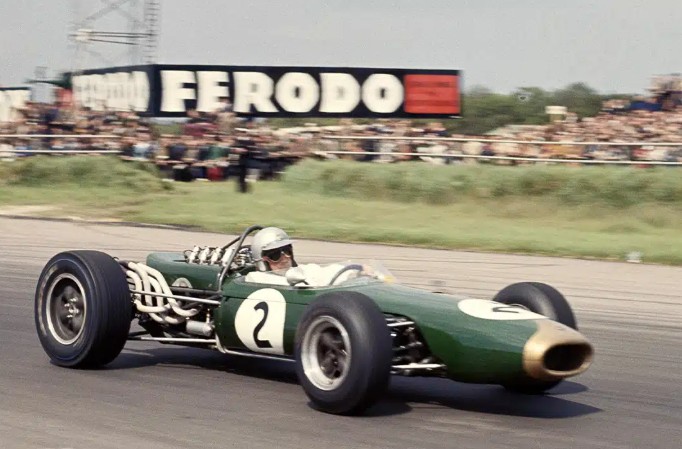
With a Repco V8 engine from Melbourne, Brabham’s English factory developed a new GP car for the 1966 season. This would become a formidable combination. That season Brabham won his third World Championship, becoming the first – and to this day the only person – to win in a car of his own construction. This, at the age of forty.
1970 would be Brabham’s last season – after 23 years of racing. He’d been winning Grands Prix, even in his retirement year. But the risks were ever present and the deaths of close drivers Brabham meant he decided it was time. At age 44 Brabham was still capable of taking on and beating the world’s best drivers.
In his autobiography, he reflected on his retirement after a discussion with his father at Zandvoort where fellow racer Piers Courage had just died; “the risks were no longer tenable. Coming from my staunchest supporter – the figure who’s always unfailingly encouraged me in the face of our womenfolk – this moment was decisive… but looking back I feel I could have had at least another three to four years in my tank”.
He managed the team and race car building company, added car dealerships, garages and an aviation company to his businesses and even well after he’d sold his racing car company, the Brabham F1 cars won the 1981 and 1983 World Championships.
In 1979 he would become one of a very small number of people to be knighted for distinguished services to motor sport. He was the first person to be offered a Knighthood in the field post-war.
Sir Jack took up occasional invitations to race – “really just for fun”. There was an ill-fated attempt at Bathurst co-driving with Stirling Moss in 1976, and one somewhat more successful with his son Geoffrey in 1977.
Then came the historic events – and who better than one of the greatest historic drivers to be involved? Sir Jack became a favourite with organizers, spectators and fellow drivers, participating in events around the world. He sold his last garage in 2002, effectively retiring from business at age 76.
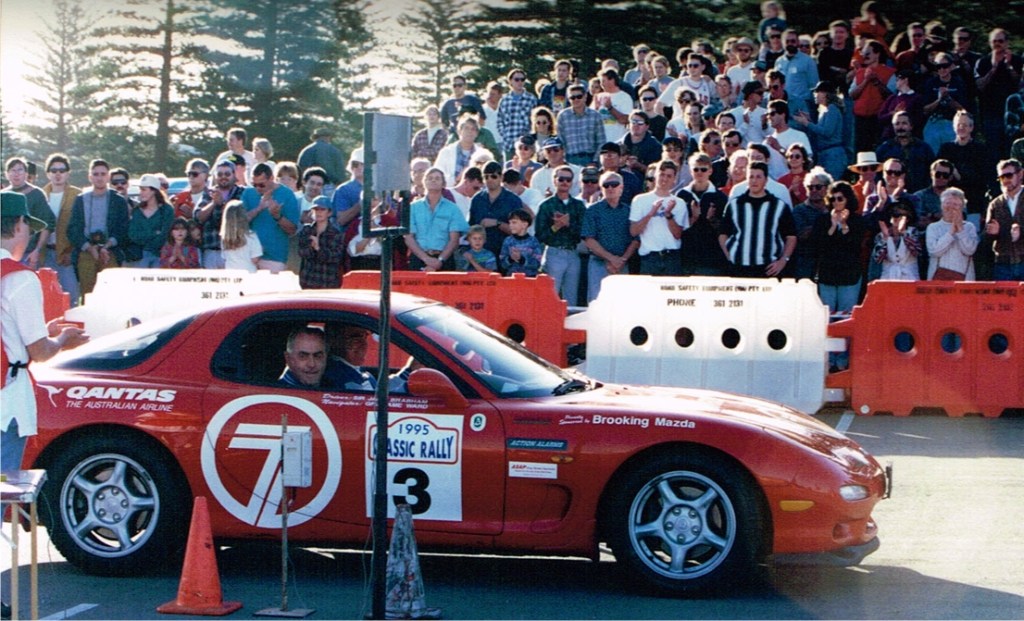
He competed twice in the Classic Rally in Western Australia. He was an immensely popular celebrity driver. Everyone found Sir Jack to be accommodating and helpful, always with a fascinating tale to tell – and still a competitive driver. Brabham amused the audience at the Presentation Night one year, telling the crowd “I’m pretty deaf you know, so my navigator had to yell out the instructions of where to go. I couldn’t hear him anyway, so I just went for it in any case!”.
He told how he was pleased that people in Perth remembered him well (he always had a crowd around), as he hadn’t competed in WA since 1965.
Fast forward to today. We’re at the Classic Adelaide rally, of which Brabham has been the Patron since its inception ten years ago. He’s taken some time out before the start to come to a studio to take some portraits while I interview him. Sir Jack’s at ease – he’s been doing this for sixty years.
After too many years listening to racing car engines his hearing has suffered, and he moves slower than he once did, his eighty years showing.
Today in his retirement he’s feted at major car events which he travels to around the world. “I’ve been to the UK two or three times a year the last few years” he says, “this year I attended both events at Goodwood and the British Grand Prix. On one of those trips I also went out to Thruxton to see an F3 race”.
“I always make sure I go to the Australian Grand Prix of course and also went to Laguna Seca (in the USA) this year for the 50th Anniversary of Cooper event.”
When asked does he have other interests outside the motoring world, Sir Jack responded “We don’t get much time for other interests these days”. Among his major interests, he’d been a very keen pilot for many years, but had finally given up flying a few years ago when he sold his farm and no longer felt he needed to fly.
Many personalities of the F1 world flew in the 1960s. “I’d always revelled in its excitements and how, like racing, it can highlight character.”
He recalled an incident when racing car constructor John Cooper had a small accident on landing his father’s Piper. Lotus founder Colin Chapman was on board and on getting out and inspecting the damage noted that there was a fuel leak. Chapman’s immediate comment was that the aircraft should be set alight and an insurance claim made. Cooper hesitated and replied that he was unsure whether the premium had been paid. “The fire crew arrived and the chance had passed. That was the difference between Cooper and Chapman” Brabham says.
In another incident he recalls flying a twin-engined De Havilland Dove near Le Mans with his parents on board. After an oil pressure problem in one engine “I shut down the engine and radioed a nearby military airfield for permission to land”. He noticed his mother staring intently at the feathered engine “No Mum,” he said pointing to the other side “that’s the engine to watch, the only one keeping us up here.”
Given that Jack Brabham inspired so many people in his lifetime, I ask him who his own heroes were. He quickly responded “The first one is Fangio. And (Stirling) Moss was as good as any competitor was.” After more consideration, he added “And (Jochen) Rindt was really fantastic to drive with”.
Asked about anyone inspirational outside the motor sport world, he said that some of the tennis greats impressed him over the years.
I ask about his feelings on Formula 1 today and he’s quick to say “I’m glad I don’t have to fund a team these days. It’s very technical and is hardly a sport any more, just a business. There’s nowhere near the pleasure in it that we used to have.”
This is a man remembered for approaching the Dutch Grand Prix starting grid on foot, stooping with a walking stick and fake long beard after his fortieth birthday. You wouldn’t see that today. And of course, he won the race.
As we speak, there’s plenty of evidence of the dry sense of humour for which he’s been well known over the years – the typically Aussie wit, as he makes wise cracks like your grandfather might. He warns our photographer about his flash “You’d better be careful you know, that thing might go off.”
I ask him to cast his mind back over the hundreds of race cars he’s been behind the wheel of. Which stands out the most? “The race car I enjoyed the most was the last Brabham I drove in 1970. And the 1966 Repco Brabham was very good too.” He hasn’t kept any of his old racers, or ever had the inclination to. They were just machines built to do a job as well as possible. No sentimentality was built into them.
And the best road car? He’s driven many a fine road car over the years too. “I’d have to say the Mercedes 500SL sports car is as good as you’d want”, referring to the previous R129 model. When at home at Surfers’ Paradise, Brabham drives a Honda Accord Euro, claiming that “while the Mercedes-Benz is a magnificent car, I wouldn’t invest so much money in a car”. He adds that the latest S-Class Mercedes is very nice and “would have to be the perfect car to drive from Adelaide to Brisbane or any long drive”.
Brabham was undoubtedly an incredibly talented driver, brilliant engineer and gifted manager. Anyone around him during our time together felt the genuine honour to be in his presence, to be chatting with a real hero.
The benefit of hindsight is a fine thing, so when I asked whether he’d have changed anything if he could have in his eighty years, he gave a considered, but resolute answer, ”I’ve really had a lot of fun. It’s been fantastic really. I’ve had a very full life”.
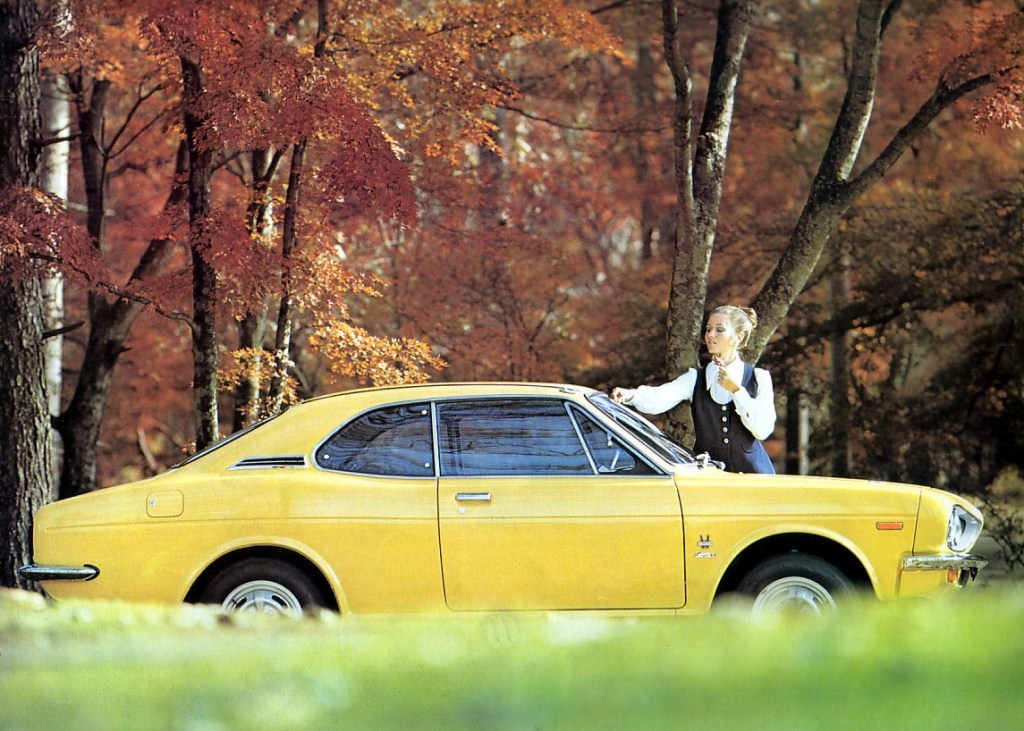
Now and then you’ll see a car from the ‘70s which rings a bell somewhere in the back of your memory. An occasional sighting of a Honda 1300 Coupe might just get some of your synapses snapping, taking you back to a time when these high-tech Japanese cars were seen on our roads.
And outside of Japan, Australia was the most likely place you’d see one.
Having achieved world domination in selling motorcycles, on entering the car market, Honda was keen to establish a wide range of cars, starting with the little S500/600/800 sports models and small commercial vehicles.
By the end of the 1960s, their cars ranged from the small Kei cars, the N360, called the Scamp in some markets, through the stylish S800 sports and Coupe to the larger 4-cylinder 1300 range of 4-door sedans.
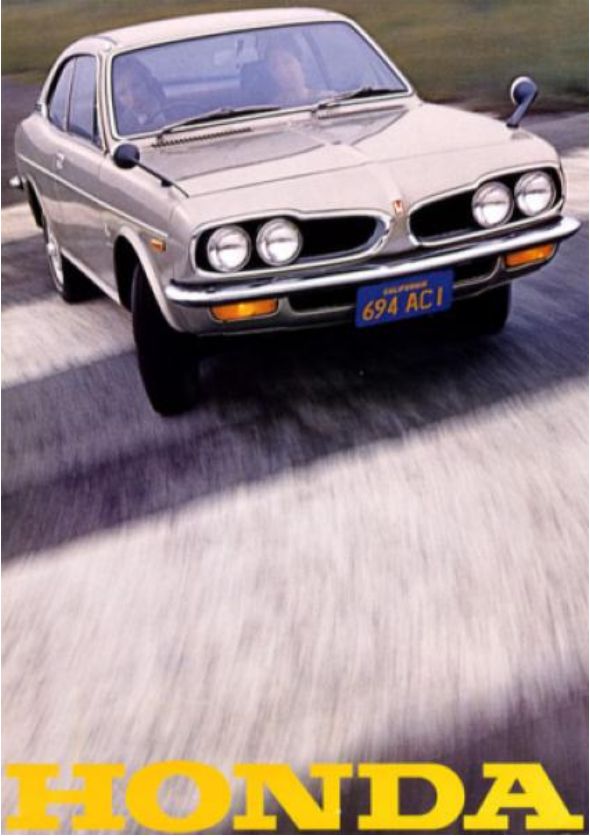
Then, derived from the 1300 sedans were the very attractive Coupe 7 and Coupe 9, as top of the range versions. The first Coupes were sold as 1970 models. Featuring sleek fastback bodywork, and distinctive split-grille front styling, these cars incorporated many of the sorts of excellent high-tech features for which Honda was famous.
The Coupes were a big step, and a big statement for Honda. They were in fact, the last model that company founder Soichiro Honda was involved with the development of. The transversely-mounted, aluminium alloy engine of the Coupe 9 featured four Keihin carburettors and a dry sump lubrication system – real racing car level of technology, which only the most exotic Italian supercars shared. The engine was also air-cooled – pretty radical for a front engined car at that time. Mr Honda’s creatrive influence was pretty clear.
Other technical features included front wheel drive, a forged steel, nitrided double-counterweighted crankshaft and chain drive from engine to gearbox, plus a side-mounted clutch – able to be changed in just 30 minutes. Standard fitment was a 4-speed gearbox, though for the Japanese market an auto was offered, and late in the model life, a 5-speed manual was optional.
Honda’s engine construction was dubbed Duo Dyna. Two fans forced air through cavities, much like a water pump would on a liquid-cooled car. One fan forced cooling air through the passages, while a second fan blew the heated air from the engine.
The 1298cc engine produced an impressive 85kW (116 bhp) at 7300rpm, or (95 bhp) in the cheaper, single carburettor Coupe 7. The high performance 9 also boasted a higher compression ratio. The Coupe 9 weighed 905kg, which seems light today but compares to 940kg for a Mk1 Celica or 966kg for a Ford Capri. Speeds achievable in the gears were 55, 93, 138 and 185km/h – very good performance for a 1300cc car in 1970. The 0-100km/h time for the 9 was 11.5 seconds and the 7 was a second slower.
Suspension was all independent, with McPherson struts up front. Steering was rack and pinion and front disc brakes were fitted. The Honda Coupes handled very well for their era, with excellent stability and handling which was greeted well by the press at the time. While they had quite a bit of bodyroll, the road-holding is still pretty good. In 1971 Wheels magazine tested the car and were very impressed, saying “We tested the Honda on the greatest variety of roads we could find and we say its suspension is one of the best-sorted of any car, regardless of size or configuration.”
Front wheel drive was still unusual back then and gave extra space in the cabin, which was probably necessary as the Coupes were claustrophobically upholstered, completely in black. The interior was certainly well decked-out, with comfortable reclining seats, comprehensive instrumentation and a stylish 3-spoke sports steering wheel.
In 1971 the Coupe 7 was listed in Australia for $2894 and the Coupe 9 for $3180. These prices compared to a Mazda R100 Coupe for $2695, a Mazda Capella RE Coupe $3333, Ford Capri Deluxe 1600 for $2775 or Capri XL $3040. In the more overtly sporty competition, a Fiat 124 Sport 1600 BC was $4250 and a Datsun 240Z would have set you back $4666.
After just two years, the models were dropped from all export markets, as the huge-selling Honda Civic was ramped up. An updated version of the Coupe, called the 145 was sold in Japan for a period.
These Hondas are virtually unknown outside Japan, except in Australia where they were sold in reasonable numbers. Very small numbers were sold in other Asia-Pacific countries. Interestingly, it’s one of the few vehicles which was never sold in New Zealand, though a few migrated as private imports. The Coupes were evaluated for the American market and even a brochure featuring a US registered car was made, but no sales were made there. Equally Europe and the UK never saw sales of these cars.
The Honda dealership network in Australia had found its legs by this period, with popular small models such as the Scamp, Life and Z all doing well. Legend has it that all of the Australian delivered 1300 Coupes were originally “S” models (with all the extras), but when they landed here, they risked attracting higher insurance fees (due to anything with an “S” or “GT” being regarded as a Sports version), so the dealers replaced all “S” badges with “Deluxe”.
They were also raced and rallied with some success by Aussie enthusiasts who appreciated their high tech specs, the cars even featuring in the Bathurst enduros. In 2008 in Victoria a 1972 Coupe 9S was offered for sale, the owner stating the car was; “Believed to be 1 of 3 built by Honda Japan for rally and race, but never raced or rallied”.
By today’s standards, the Coupes are still relatively easy to drive. There’s no power steering, but it’s only at parking speeds that you notice. The rack and pinion steering still shows eagerness to turn in well when approaching a corner. Inside, the seats feel a bit flat but the driving position is quite good – if a bit like an Italian car of the era. The steering wheel seems set quite high, possibly exacerbated by the tail-down stance the Coupes have.
You can see that car makers have learned from the black with black on black interiors that some designers thought was sporty in the 1970s.
From driving a Coupe 9 some years back I recall that if you ring the neck of the eager engine, the performance is pretty good – this of course being relative to the era of the car.
Fortunately for 1300 Coupe owners, sales figures are available; about 38,000 of the Coupes were made, with 1053 being exported, 731 of which were sent to Australia. The breakdown was: NSW 235, Victoria 176, WA 168, SA 62, QLD 51, Tasmania 33 and ACT 6.
Today, probably because of their fascinating mechanical layout, a few remain in existence in each state though their values are still relatively low. Only a handful of these survivors remain on the road today. Old age has caught up with most of these cars, most of which are in need of some love. The rarer 4-carby Coupe 9 is the much more collectable version.
Are they a significant classic or a piece of curious marginalia? Even with increasing interest in Japanese classics, I’d probably be leaning more towards the latter…













 Paul Blank