
by Paul Blank
Three time Formula 1 World Champion and the only person to achieve a championship win in a car of his own construction. Twice I hosted Sir Jack when he was a star driver in the Classic Rally I ran in Western Australia. I got to know him then and in 2006 at the Classic Adelaide Rally, interviewed him for a magazine article.
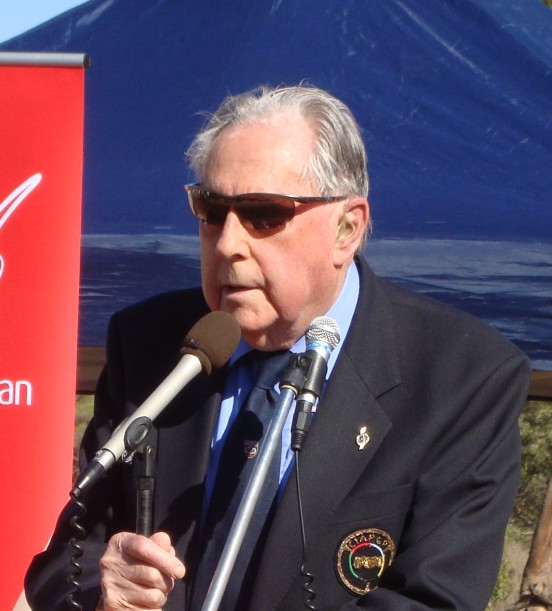
Above: Sir Jack aged 85 in 2011 at the old Caversham racetrack addresses the crowd at the naming ceremony for the suburb which would bear his name. Photo: Paul Blank
2006: He’s one of our nation’s greatest sporting heroes and a man whose achievements in motor racing are unequalled around the globe. But there’s a younger generation of Australians who might be familiar with the name, but don’t really know what Sir Jack Brabham is all about and why he should be so revered as such an all-time great.
Today he is eighty years old – and has long been the oldest living Grand Prix World Champion “I’m six months older than Phil Hill” the American World Champion from 1961, Sir Jack proudly pronounces. He’s from an era when driving a Grand Prix car was an extremely dangerous occupation – many of his contemporaries died while racing. And anyone reaching eighty today has made an achievement in that itself.
It was forty years ago that Jack Brabham won the last of his Formula 1 World Championship races.
Born into an everyday kind of Australian family, his racing began way back in 1948 when he took over a friend’s dirt track speedway car he’d helped build, and within a remarkably short space of time had become a winner. In fact, in his first season at the big Royale Speedway at the Sydney Showgrounds, he came away NSW Champion.
Throughout his racing career, Brabham’s keen engineering insight meant that he was often able to keep a car going when others’ would expire.
Speedway led to circuit racing and the odd hillclimb which took Brabham to other states in Australia to compete. In 1954 he was invited to his first overseas race at Ardmore near Auckland for the New Zealand Grand Prix. There he met for the first time a young Bruce McLaren, who would later race for Brabham and eventually become a race car maker himself. McLaren’s name lives on in race and road cars today.
After a string of successes down under, the call of Europe was too strong for Brabham to resist and in 1955 he took the plunge. He was a well enough respected driver to be racing an F1 car that same year.
Back to Australia for our summer saw him win the Australian Grand Prix, before heading to Europe for a second season. After a disastrous fling with an Italian mistress – a Maserati 250F – support by the Cooper team gave Brabham the fillip he needed for real success. This was a period where Cooper’s avant garde lightweight, mid-engine racers started to show promise against the big front-engined Grand Prix cars.
The first Grand Prix win came Brabham’s way in 1959 at Silverstone, followed by his first World Championship race win at Monaco – and what began as a trickle would become a torrent. Brabham was crowned World Champion at the finish of the 1959 season. The first ever Australian champion.
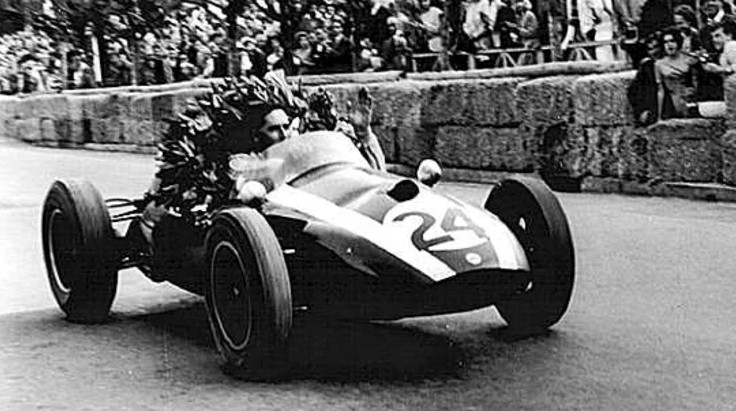
To emphasise his brilliance, Brabham backed up his success by taking away the 1960 World Championship as well.
The early 1960s saw Brabham develop his own cars, something which a small number of other drivers had done through the years. His engineering skills along with others, notably Ron Tauranac, produced some searingly effective cars.
He also ran the team of Brabham cars in Grands Prix. His company was becoming a very successful manufacturer and seller of its racing cars of various classes too, becoming the world’s most prolific maker.
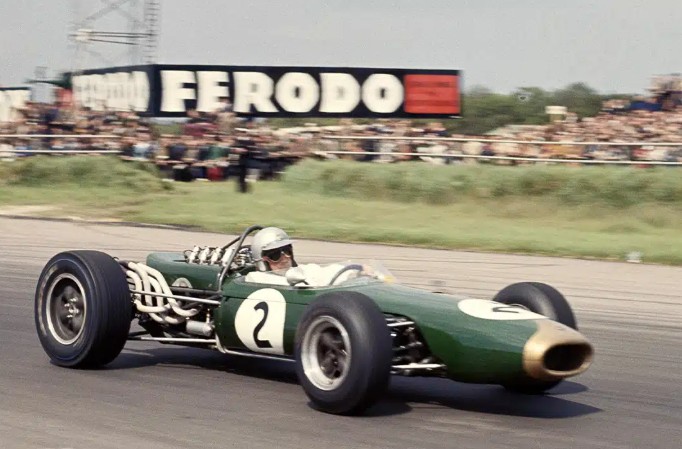
With a Repco V8 engine from Melbourne, Brabham’s English factory developed a new GP car for the 1966 season. This would become a formidable combination. That season Brabham won his third World Championship, becoming the first – and to this day the only person – to win in a car of his own construction. This, at the age of forty.
1970 would be Brabham’s last season – after 23 years of racing. He’d been winning Grands Prix, even in his retirement year. But the risks were ever present and the deaths of close drivers Brabham meant he decided it was time. At age 44 Brabham was still capable of taking on and beating the world’s best drivers.
In his autobiography, he reflected on his retirement after a discussion with his father at Zandvoort where fellow racer Piers Courage had just died; “the risks were no longer tenable. Coming from my staunchest supporter – the figure who’s always unfailingly encouraged me in the face of our womenfolk – this moment was decisive… but looking back I feel I could have had at least another three to four years in my tank”.
He managed the team and race car building company, added car dealerships, garages and an aviation company to his businesses and even well after he’d sold his racing car company, the Brabham F1 cars won the 1981 and 1983 World Championships.
In 1979 he would become one of a very small number of people to be knighted for distinguished services to motor sport. He was the first person to be offered a Knighthood in the field post-war.
Sir Jack took up occasional invitations to race – “really just for fun”. There was an ill-fated attempt at Bathurst co-driving with Stirling Moss in 1976, and one somewhat more successful with his son Geoffrey in 1977.
Then came the historic events – and who better than one of the greatest historic drivers to be involved? Sir Jack became a favourite with organizers, spectators and fellow drivers, participating in events around the world. He sold his last garage in 2002, effectively retiring from business at age 76.
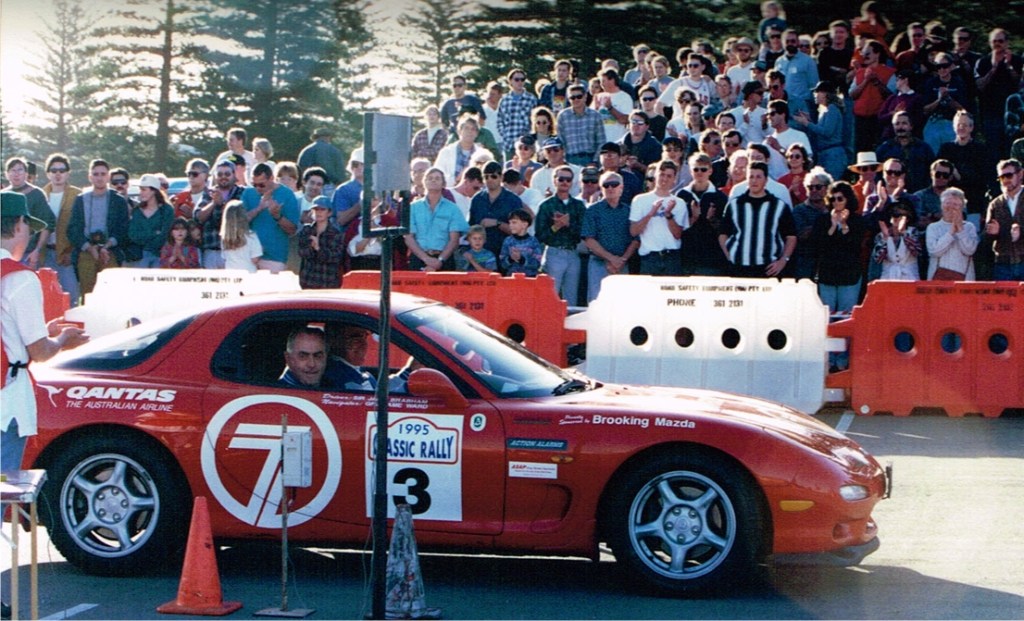
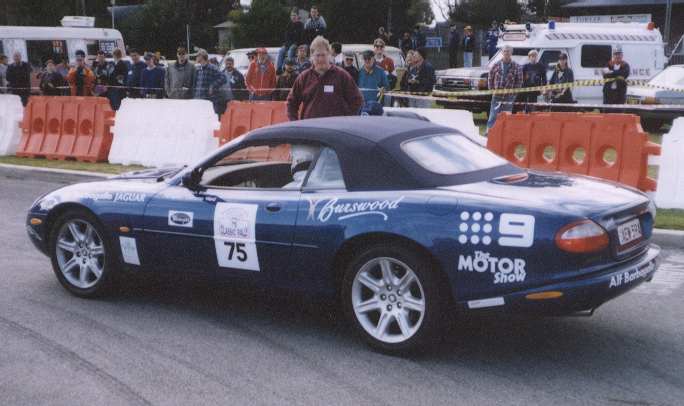
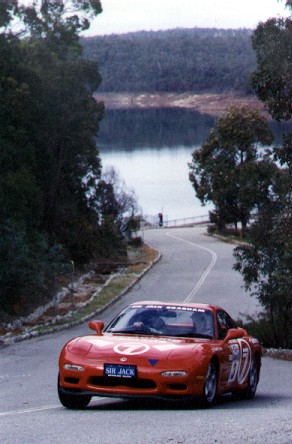
He competed twice in the Classic Rally in Western Australia. He was an immensely popular celebrity driver. Everyone found Sir Jack to be accommodating and helpful, always with a fascinating tale to tell – and still a competitive driver. Brabham amused the audience at the Presentation Night one year, telling the crowd “I’m pretty deaf you know, so my navigator had to yell out the instructions of where to go. I couldn’t hear him anyway, so I just went for it in any case!”.
He told how he was pleased that people in Perth remembered him well (he always had a crowd around), as he hadn’t competed in WA since 1965.
Fast forward to today. We’re at the Classic Adelaide rally, of which Brabham has been the Patron since its inception ten years ago. He’s taken some time out before the start to come to a studio to take some portraits while I interview him. Sir Jack’s at ease – he’s been doing this for sixty years.
After too many years listening to racing car engines his hearing has suffered, and he moves slower than he once did, his eighty years showing.
Today in his retirement he’s feted at major car events which he travels to around the world. “I’ve been to the UK two or three times a year the last few years” he says, “this year I attended both events at Goodwood and the British Grand Prix. On one of those trips I also went out to Thruxton to see an F3 race”.
“I always make sure I go to the Australian Grand Prix of course and also went to Laguna Seca (in the USA) this year for the 50th Anniversary of Cooper event.”
When asked does he have other interests outside the motoring world, Sir Jack responded “We don’t get much time for other interests these days”. Among his major interests, he’d been a very keen pilot for many years, but had finally given up flying a few years ago when he sold his farm and no longer felt he needed to fly.
Many personalities of the F1 world flew in the 1960s. “I’d always revelled in its excitements and how, like racing, it can highlight character.”
He recalled an incident when racing car constructor John Cooper had a small accident on landing his father’s Piper. Lotus founder Colin Chapman was on board and on getting out and inspecting the damage noted that there was a fuel leak. Chapman’s immediate comment was that the aircraft should be set alight and an insurance claim made. Cooper hesitated and replied that he was unsure whether the premium had been paid. “The fire crew arrived and the chance had passed. That was the difference between Cooper and Chapman” Brabham says.
In another incident he recalls flying a twin-engined De Havilland Dove near Le Mans with his parents on board. After an oil pressure problem in one engine “I shut down the engine and radioed a nearby military airfield for permission to land”. He noticed his mother staring intently at the feathered engine “No Mum,” he said pointing to the other side “that’s the engine to watch, the only one keeping us up here.”
Given that Jack Brabham inspired so many people in his lifetime, I ask him who his own heroes were. He quickly responded “The first one is Fangio. And (Stirling) Moss was as good as any competitor was.” After more consideration, he added “And (Jochen) Rindt was really fantastic to drive with”.
Asked about anyone inspirational outside the motor sport world, he said that some of the tennis greats impressed him over the years.
I ask about his feelings on Formula 1 today and he’s quick to say “I’m glad I don’t have to fund a team these days. It’s very technical and is hardly a sport any more, just a business. There’s nowhere near the pleasure in it that we used to have.”
This is a man remembered for approaching the Dutch Grand Prix starting grid on foot, stooping with a walking stick and fake long beard after his fortieth birthday. You wouldn’t see that today. And of course, he won the race.
As we speak, there’s plenty of evidence of the dry sense of humour for which he’s been well known over the years – the typically Aussie wit, as he makes wise cracks like your grandfather might. He warns our photographer about his flash “You’d better be careful you know, that thing might go off.”
I ask him to cast his mind back over the hundreds of race cars he’s been behind the wheel of. Which stands out the most? “The race car I enjoyed the most was the last Brabham I drove in 1970. And the 1966 Repco Brabham was very good too.” He hasn’t kept any of his old racers, or ever had the inclination to. They were just machines built to do a job as well as possible. No sentimentality was built into them.
And the best road car? He’s driven many a fine road car over the years too. “I’d have to say the Mercedes 500SL sports car is as good as you’d want”, referring to the previous R129 model. When at home at Surfers’ Paradise, Brabham drives a Honda Accord Euro, claiming that “while the Mercedes-Benz is a magnificent car, I wouldn’t invest so much money in a car”. He adds that the latest S-Class Mercedes is very nice and “would have to be the perfect car to drive from Adelaide to Brisbane or any long drive”.
Brabham was undoubtedly an incredibly talented driver, brilliant engineer and gifted manager. Anyone around him during our time together felt the genuine honour to be in his presence, to be chatting with a real hero.
The benefit of hindsight is a fine thing, so when I asked whether he’d have changed anything if he could have in his eighty years, he gave a considered, but resolute answer, ”I’ve really had a lot of fun. It’s been fantastic really. I’ve had a very full life”.
Copyright Paul Blank
 Paul Blank