

This week I’m testing the Hyundai Ioniq 9 Calligraphy – a 7-seater luxury EV. It’s certainly big, plush, quiet and well equipped. At a smidge under $120,000, it’s pushing well into Genesis territory, but that can probably work for the company.
There’s strong acceleration – 0-100km/h in 5.2 seconds, with much less intrusive electronic nannying than many other recent models from Hyundai – seems they’ve been taking the feedback on board.
The Ioniq 9 feels well planted on the road, handles well for a 2.5 tonne SUV. The WLTP claim is a 600km range.

The top of the line Calligraphy has everything they can throw at it. Except Australia doesn’t get the option of swivelling centre row seats that other markets do. There are special finishes, heated and cooled front and rear seats, dozens of cup holders, 21-ich wheels (of a rather dated, fussy design), triple zone climate control, panoramic glass roof, lovely feeling suede-like roof lining and many more details.
But the $3000 option gimmick cameras and screens in place of door mirrors is frustrating at best – dangerous at worst. You have to focus on the screen, not using the depth of field as with a normal mirrors or looking through the windows. Loses a fraction of a second. Terrible for anyone who needs glasses. And hard to judge gaps (when reverse parking for example). The image doesn’t give the additional information a brain can take on board by moving your head a bit. I’ve used this in several cars now. More car makers will use this expensive gimmick to seem high tech. It’s a retrograde step.
The boot floor is crazy high, like almost every new SUV, especially EVs. And it’s not concealing a spare wheel. Boot space with seats up is not generous. There is a small frunk.
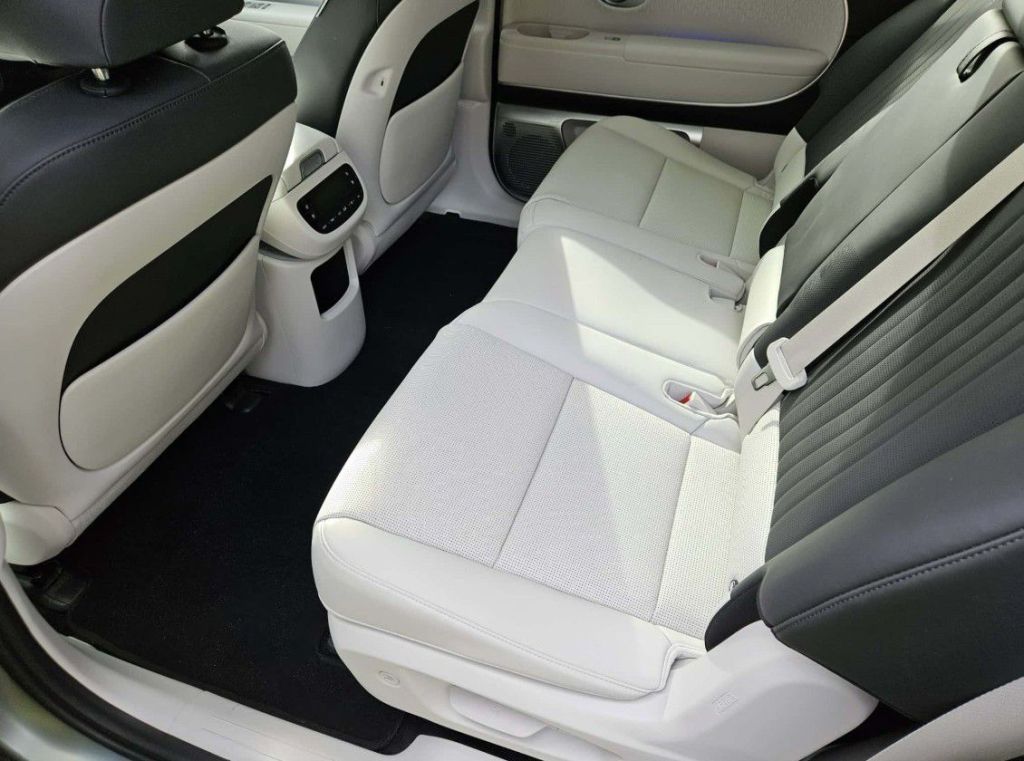
Space in the front two rows is excellent – almost limousine-like for the centre row passengers.
There’s an 8-year warranty – and unlike sone of the unknown new brands, Hyundai will still be around to honour it – while parts availability and servicing will be to their usual good standard.
And I don’t mind the styling, especially the back end.
Paul Blank


 Paul Blank