The Abarth name refers to performance versions of Fiat products. And so it is with the sportier version of Fiat’s electric 500e.
The Abarth 500e boasts a beefier looking body kit with deep front spoiler, larger wheels wearing low profile tyres, adjusted suspension, body hugging front seats and lots of Abarth badges.
It also has a handy lift in performance over the standard 500e – not hard to achieve in an electric car, but oddly, while it’s quick-ish, the Abarth isn’t quite as fast as the old petrol Abarth version of the 500. The performance helps make it a nimble car around town, with the sporty handling emphasizing the nature of the car. It’s certainly got plenty of fun factor built in.
Front seat ergonomics are a big improvement over the slightly smaller old petrol 500, though back seat space hasn’t improved – particularly the shortage of rear legroom. There are some small ‘surprise and delight’ features inside. Like the electric button internal door releases… The row of ‘gear’ selection buttons on the dashboard is simple and nice – better than the gimmicky controls many other makers have for gear selectors.
One big gripe I have with all the electric 500s is that they’re specified for the Australian market with a glass roof panel. It’s a car clearly designed and tested in a European winter. There’s a retractable internal roof blind, which has more perforation than material. The glass gets hot even on a moderately warm day and the heat radiates in. I found I was getting sunburnt, even though the glass is (lightly) tinted. I ended up putting a cut-to-fit foam board in as a roof lining. Presumably installing a strong reflective window tint would help a lot…
For the launch, the importers have brought some excellent colours – like the tennis ball flouro green of the car I tested. There’s also a very attractive bright blue.
There’s an optional fitment of a sound generator, which the test car didn’t have – basically a speaker under the back bumper simulating exhaust sounds. Nowhere near as sophisticated as Hyundai Ioniq 5N’s in-car sounds and from all reports, the Abarth system is more gimmick than fun.
When I’ve been in Europe recently, it’s been clear that the take-up of the 500e as a city car has been pretty good. The claimed range for the Abarth is 253km, so it doesn’t stack up as a long-distance cruiser (all electric cars really don’t), but that’s not what the 500e is intended for. Around town, it can be a ball of fun.
Two versions, just below and just above $60,000 were offered initially – and now the importers and dealers have been slashing the price to clear stock, as market resistance has been too strong to sustain such a high price.
Alfa Romeo Montreal. Race-bred engine, show car body – what a combination! But one of the most misunderstood cars of the 1970s would have to be the Montreal. It was a fascinating car, featuring a unique, race-bred quad-cam, dry-sump V8 engine, show-car bodywork and was produced in very small numbers. But today only a small number of people seem to recognise them and few enthusiasts crave a Montreal so values have took a while to rise while other cars around them skyrocketed.
So what was this mysterious Italian exotic all about? The company had a long and illustrious history in racing and building high performance cars, but it had been some time since they’d built anything like their own supercar.
Financially, in the late 1960s the Alfa Romeo company was in a pretty good position. Sales in the last decade were strong around the world, their model range was expanding – Alfas were doing well in several racing categories and the future looked rosy.
Milan-based Alfa Romeo was invited to be the sole car manufacturer to exhibit at the Expo 67 World Fair, a huge exhibition staged in Montreal, Canada which opened in April 1967. The show celebrated 100 years of Canadian Federation and nations were invited to show their finest achievements in culture, science and technology. There was a section entitled “Man the Producer” and Alfa Romeo was the only car maker invited to show their vision of the future.
Seizing the opportunity for such a high profile occasion, the Alfa bosses contracted coachbuilders Bertone to design a show car especially for the Expo. Bertone and Alfa Romeo had a long relationship which had been immensely successful for both companies.
The resulting design was based on the floorpan and running gear of the popular 105-series coupe and featured flamboyant styling, with an assortment of vents and gills as the hallmarks of the sleek design. The engine was the 1.6-litre version of Alfa Romeo’s venerable twin-cam 4-cylinder unit.
Two identical show cars were built and from the moment they were shown at Montreal, they received excellent reviews from the media and public. Period publications complimented the balance and proportions of the design.
The styling had been done while two greats, Giorgio Giugiaro and Marcello Gandini worked at Bertone, and like other Bertone cars of the era, there remains some discussion about who was responsible for the design… Most likely the work was begun by Giugiaro and finished by Gandini.
On the strength of the show car’s great reception, Alfa Romeo’s management decided that the show car presented them with the opportunity they wanted to build a new top of the range sports car. Apparently there were many arguments within management about how the car should be – but keep in mind that Alfa Romeo was an Italian company…
Ultimately the decision was made to incorporate a version of the successful Tipo 33 V8 engine which had powered various Alfa racing cars to many competition successes in recent years. The 2593cc V8 featured a quad-cam layout, dry sump lubrication, electronic ignition and Spica fuel injection. This was as high tech as you got in the early 1970s. For the application of the new road car, it would produce 150kW (200bhp).
Also specified were an (expensive) robust German ZF gearbox, with dogleg first gear plus a limited slip diff, with its own oil cooler were included. The show car bodywork was adapted to fit the bigger engine and a multitude of minor changes were made, but the overall look of the car remained very much the same when production began 3 years later.
Bertone was contracted to assemble the cars for Alfa Romeo, at its Grugliasco plant, alongside Lamborghini Miuras, Fiat Dino Coupes and 850 Spiders.
The resulting car, named Montreal after the Expo venue, was launched at the Salon de Geneva in 1970.
With it’s magic engine, the Montreal was a quick car by the standards of the early 1970s, capable of 230km/h. 0-100km/h took 7.1 seconds. It could show a Porsche 911 a clean set of heels.
At much the same time as the new range-topping coupe came on stream, Alfa Romeo was suffering from industrial problems which beset all Italian car makers at the time. The company was also suffering issues with building a new plant in the south of Italy to build the all-new Alfasud series.
The 1973 fuel crisis really hurt Montreal sales. Nonetheless Alfa persevered with the car, and there continued to be sufficient demand until 1975 when manufacturing ceased – though the final cars were sold in 1977. Just 3925 had been built.
Unlike with some other exotics, with the Montreal, Australians were lucky – it was offered in right-hand-drive. Wheels magazine gushed enthusiastically about the first one which landed (a left-hand drive example), and called it “A half price Lambo”. They said it was “The most exciting, luxurious car the famous Italian firm has ever made.”
Offered at $11,900 sales began late in 1972, but only lasted here for a couple of years. The 1974 price had risen to $14,935.
To compare, by 1974 a Porsche 911 started at $13,460 (to $18,477 for a Carrera), a BMW 3.0CSi cost $17,950, a Ferrari 308GT4 cost $19,500 – right on par with a Urraco and a Mercedes 450SL. So the Montreal was pretty good value here.
Dealers around Australia were pleased to have such a glamour model to boost the brand’s image. The cars were offered in a range of colours, including two real stand-out metallics – orange and green. Just 44 were sold new in Australia.
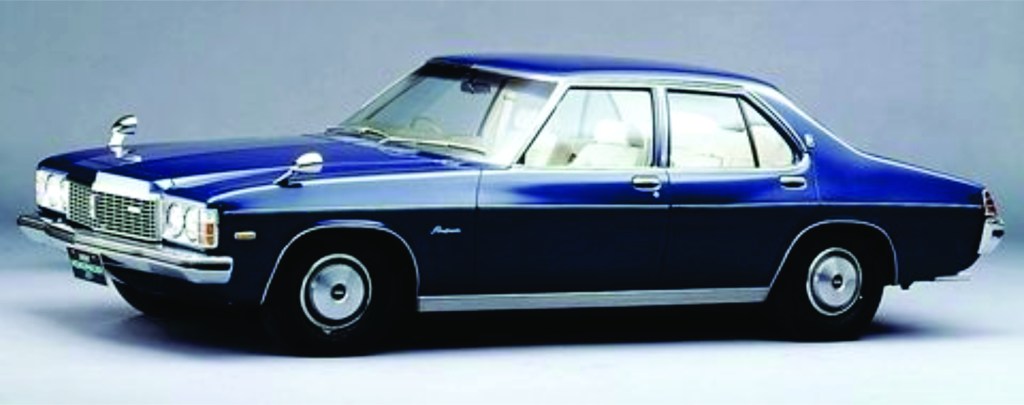
Here’s one of the most unusual of Japanese cars. It’s so unusual, that almost anyone in Australia would doubt the claim that it is a Japanese car at all.
To most Aussies it looks like a Holden HJ Premier, and those with a keen eye will note a few detail differences. The most obvious of these are the Mazda badges the car wears.
It’s a Mazda Roadpacer, born from a brief liaison between Holden and Mazda in the early 1970s.
This was a time when the larger Japanese manufacturers built exclusive top-of-the-range luxury models for executives and dignitaries, the Toyota Century, the Nissan President and to a lesser extent Mitsubishi Debonair. These cars were marketed only in Japan and the Toyota and Nissan featured unique V8 engines.
While Mazda was growing, they had no such car, nor the finances to develop one. Their model range was broad in the early 1970s, with their rotary and piston engine range of models selling well from the Kei-class Chantez 360 to the new RX5.
The Roadpacer was the result of a concept which had certain undeniable merits. Development time and tooling costs were significantly reduced compared to starting from scratch. Japan, like Australia was a right hand drive market. Also the Holden was not sold in Japan, which was the only market the new Mazda luxury model would be marketed, so it would be exclusive. Mazda did a del to buy Holden bodies, and fitted their own running gear, interior trim and other minor parts.
Compared to the Holden, the biggest change was the installation of Mazda’s 13B rotary engine, exactly as used in the RX4 – or Luce RE-AP in its home market. The 13B twin-rotor engine developed 181kW (135bhp) at 6000rpm, not a great deal for a car with the weight of a fully equipped Holden Premier – just under 1600kg. The rotary powerplant sits low and well back in the engine bay and the radiator is oddly angled.
The Roadpacer was only available with automatic transmission, a Jatco 3-speed unit, with slightly lower gearing than the Holden version to try to get some acceleration out of the car. Performance was not strong compared to its competitors, with a top speed of just 165km/h.
While the Roadpacer was one of Japan’s first cars to meet strict new anti-pollution regulations, fuel economy was not one of its highlights. No better than 15mpg could be expected. It used as much fuel as a V8-engined Premier, but had no more performance than a 3.3-litre, 6-cylinder version of the Holden.
What the Roadpacer may have lacked in outright performance, Mazda made up for in lavish equipment levels. The list of luxury fitments included air conditioning, power steering, electric windows, central locking, interior boot release, an AM–FM radio/cassette player (with additional controls in the rear), a rear window demister and remote external mirror adjustment.
Among the few options available, was the choice of bench or bucket front. The cars were upholstered in soft materials, including the felt-like hood-lining to help reduce noise levels. Some had amazing sculptured velvet Louis XIV upholstery in vile colours, which whilst very plush, were an acquired taste – to be polite. Plainer trim was also available.
Other changes were made to the car to meet Japanese regulations – big chrome wing mirrors, front side repeater lamps, reversing lamps and hazard lights. Various warning buzzers and doors that lock automatically at 10km/h were fitted.
Other differences include a unique centre console (with the separate front seat option), different hubcaps, and of course lots of Mazda badges.
It appears that there were also minor changes during production, as early press photos show reversing lights and additional reflectors hung under the rear bumper, while later cars had RX4 integral type units fitted into the bumper.
I’ve had the pleasure of driving a Roadpacer on a couple of occasions. And driving the Roadpacer is an unusual experience – not so much for the rotary engine, but that it drives just like a 1970s Holden. It even sounds like a Holden 6-cylinder until the revs get quite high and the smooth hum of the rotary becomes apparent. It glides around smoothly and comfortably, as would have been expected of it when new.
The Roadpacer was not a convincing exercise as a luxury car and the Japanese market shunned it. While it was listed as available from 1975 to 1978 (gaining an updated grille in 1977) it is unlikely that more than a few hundred were sold each year. It seems most likely that a total of just 800 were sold. It cost the same 3.8 million Yen as a V8 Nissan or Toyota, was not as luxuriously fitted out and certainly lacked the performance of its rivals.
Today, a surviving Roadpacer is a very rare car indeed. Unloved by the Japanese, only a small number remain there. Two or three examples are known to be in Australia, the best known of which is in a collection in Western Australia having previously been in two prominent WA collections. That’s it, below.
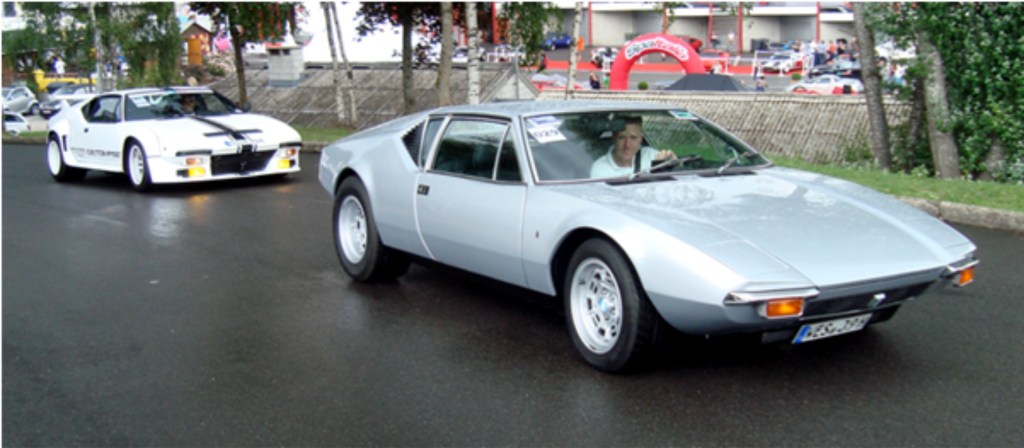
The Pantera is the only De Tomaso model which most people have ever heard of – and that’s just the car enthusiasts. Vallelunga? Guara? Deauville? There are examples of all of these in Australia, but the Pantera is the only model that rings a bell with most people.
Probably not surprising, given that the Italian maker built 10,000 Panteras over the model’s record 23-year model run and the rest in tiny numbers.
Alessandro De Tomaso was a clever man, possibly cleverer than some of the cars he made… He was a marketing genius, with good connections and a passion for exotic vehicles. The Argentinian-born entrepreneur lived his adult life in Italy and married into a very wealthy, well connected American family. His wife’s connections provided the entrée to Ford, which is where De Tomaso was able to make a very lucrative agreement. De Tomaso would build an exotic sports car for American Ford dealers to out-shout Chevrolet’s Corvette.
As part of the deal, he later sold Ghia and Vignale to Ford.
Durability also became an issue and by 1974 Ford had got too frightened by the whole thing and pulled out of the deal, though the cars remained in production for many years to come, with considerably smaller sales through De Tomaso’s own network.
In 1972 the hotter GTS was added, with bigger wheelarches covering wider wheels and more power. 1972 saw the introduction of the Pantera L, primarily to suit American regulations, with big bumpers and a ‘strangled’ engine producing less power.
Subsequent to the Ford period, De Tomaso developed several versions of the Pantera, improving performance and adding enhancements along the way. 1980 saw the GT5 join the range, featuring a huge rear wing, which became a popular fitment on many Panteras.
1986 saw the Cleveland V8 replaced by the Windsor 5.8 litre, which brought with it a drop on performance.
Next came a smooth big blister guards which modernised the look quite well.
In 1991 came the Si model, with a fuel-injected 5-litre V8 and a comprehensive restyle courtesy of Marcello Gandini. Along with bigger blister guards, a silly (Gandini trademark) spoiler at the base of the windscreen, the brakes and suspension came in for redesign in this model. Big plastic wrap-around bumpers and side sills were added, but by now they were really tarting up something beyond its use-by date.
By 1993 the Pantera was a pretty old car that had outrun its life expectancy, and production ceased.
The sales success of the Pantera made De Tomaso a wealthy man and allowed him to develop other models – always with Ford V8s even after the ‘divorce’. He ultimately also owned the Moto Guzzi and Benelli motorcycle companies, Lambretta and Innocenti and Maserati car firms. There were also newer De Tomaso models, but none than sold anywhere near as well as the Pantera.
What do you need to look for when buying a Pantera today? Well, they were not built for longevity and rust is the biggest killer. Where a Pantera has lived its life and how much rust has taken hold can be a major factor for a potential buyer – check everywhere… It’s not just exterior panels that are at risk. Make sure you get a car up on a hoist to see the underneath. Areas inside the engine bay should also be checked.
But potentially more of a problem are modifications. It seems the majority of Pantera owners over the years have not known when to leave well enough alone. There are many cars which have legitimate upgrades, but far more which have been customised by people with questionable taste. This adds nothing to the value (devalues them in some cases). Reversing unfortunate modifications can be as costly as repairing issues of wear and tear.
Probably the costliest risk area in any Pantera is the transaxle gearbox. It’s a sturdy German-made ZF unit, but they have often taken a pounding for years and when they break, they are very, very expensive…
Rebuilt engines are relatively common, unlike with other Italian exotica, because the cost is very reasonable – plus performance upgrades are attractively cheap. There are plenty of specialists who have knowledge and experience with these engines.
Worn suspension can take a lot of the joy and accuracy out of a Pantera’s handling, so should be checked for proper maintenance.
Parts availability is generally good, mostly at a fraction of the price that other exotic car parts sell for. Many of the small parts of hardware are common with other Italian cars of the ’70s. You just need to be able to identify which company made a part…
Wheels can be expensive, though there are aftermarket alternatives in the correct style, including in bigger diameters. But please don’t spoil a Pantera with different designs of wheels… Or a big, dumb wing on the back of a model that shouldn’t have one. Too 1980s.
On some Panteras the removable rear boot box has gone, sometimes to make way for an exotic exhaust system. If you want to carry shopping or luggage, you may need to find or fabricate one.
However, with values rising steadily over the past couple of decades, many Panteras have been thoroughly restored and problems like rust, cooling issues and poor fitting parts have disappeared in expensive restorations.
There has been a steady if slow influx of Panteras from the USA over the past twenty or so years, all being left hand drive. Conversions are relatively straightforward.
When looking, it’s worth first deciding which model you want. Then, look closely at any cars on the market to see whether they are genuinely the model they appear to be. If you’re happy with a GT5 clone that began life as a Pantera L, then that’s fine. Just don’t assume that a car is what it looks like. And pay accordingly.
This week I’ve been driving a new Mazda MX5. What a revelation!
After too many recent drives of SUVs with minimal driving pleasure possible, the MX5 shows there are some car designers and manufacturers out there who understand the simple joys of driving – and of producing a driver’s car without a crazy price tag. The MX5 range starts at $46,400.
The latest MX5 retains the simplicity of analogue driving pleasure, but has adopted all the necessary electronic gimmickry needed to still score enough ANCAP testing points. Yes, there’s a rear view camera, cross traffic alert, (switchable) lane assist, blindspot warning etc, etc, but the joy of perfectly weighted steering which gives such accurate response, a beautiful to use gearchange, the sweetest handling add up to an most unusual pleasure.
Like all MX5s, the engine power isn’t crazy, but is just right for getting the balance of handling spot-on. It’s smooth and torquey for a pretty normal kind of engine – and the 6 gears have beautifully selected ratios. There’s no scuttle-shake and the ride is impressively supple whilst remaining resolutely sporty. It handles speed bumps better than all the recent SUVs I’ve tested.
The inside fits like a comfy glove – the heated seats and powerful heater let you enjoy a cold winter’s day with the roof down. The splash of body colour on the door tops is very nice – even in a car with a colour best described as Metallic Dirt.
The styling isn’t their best effort, the design of the wheels fitted to the review car do it no favours, but these are easy to overlook when the package is so compellingly good.
The manual roof mechanism is the easiest I’ve ever used. The MX5 is completely easy to drive and as economical as a small hatchback.
Congratulations and Thank You to the folks at Mazda for producing such a car.
Thinking outside the automotive square is not a new phenomenon. Perth in Western Australia is one of the most far flung outposts. Originally a British colony, its residents are often proud that it is the most isolated capital city in the world.
In the early days of motoring, the cars of Perth generally fell in to two groups, small English cars and large American cars. Some European makes also flourished briefly, mainly with smaller cars too. West Australian roads provided a tough environment for cars, especially with the vast distances and few sealed roads outside of the Perth metropolitan area.
By the late 1920s the Perth Police had a lot of ground to cover, and a ramshackle collection of vehicles for patrols – few of them very capable in a pursuit. The best were four Ford V8s and a Harley Davidson motorcycle they had in addition to some worn out cars as old as 1913.
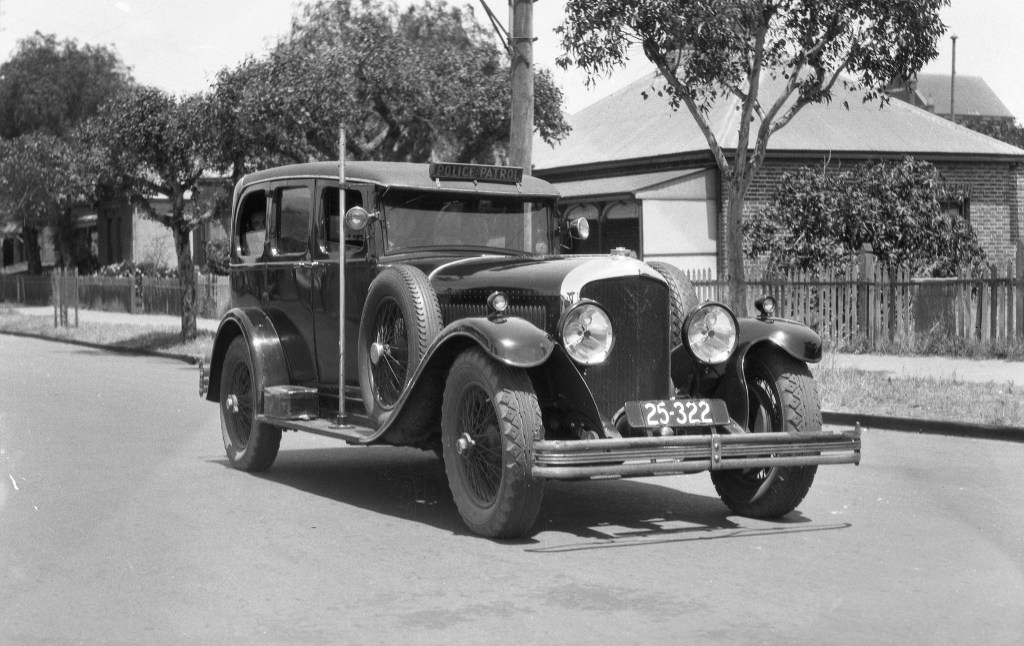
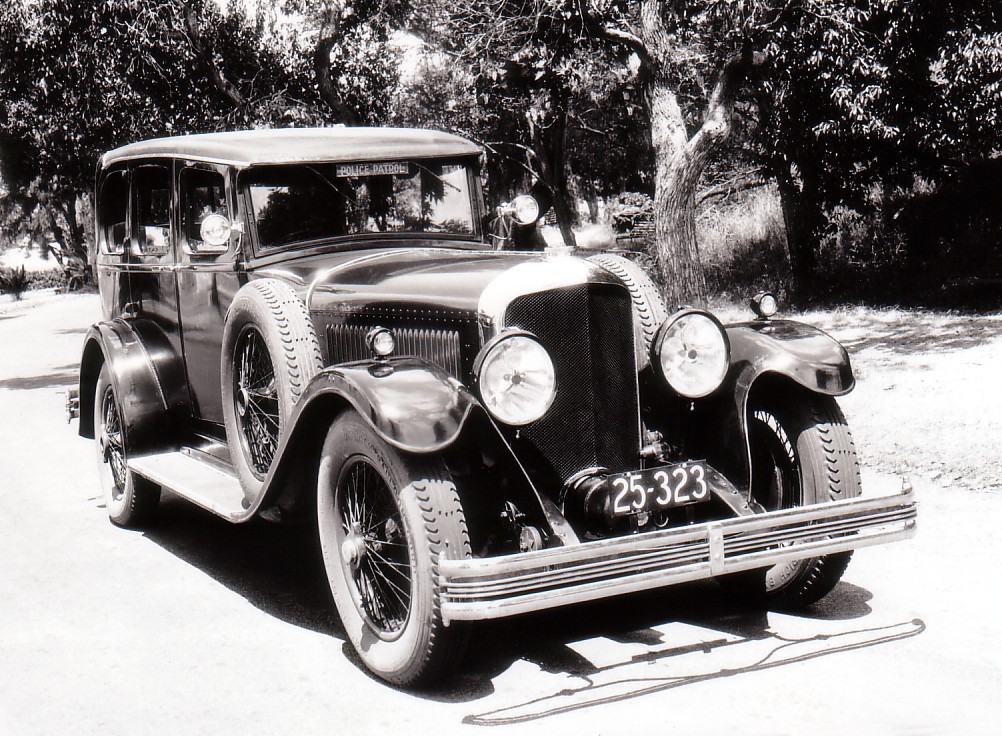
While the start of the Depression was beginning to bite in Western Australia, in April 1930 the Police Commissioner gave a recommendation to Parliament which led to the Agent General in London ordering two new Bentley Speed Six chassis for Police use. This is as remarkable as a Police department ordering new Bentley Arnages today… How could such extravagance be justified?
Somehow the idea was dreamt up that while Perth needed new Police stations, if these cars were to be equipped with two-way radios, it would obviate the need to build ten stations. A pair of Bentleys would cost less than ten buildings. And everyone seemed to like the idea…
Two-way radios were a novelty in 1930, and the Police Bentleys would become the first police cars in the world to be fitted with such units.
The Daily News announced in an article on May 12, 1930, “War on Motor Crooks”. The article went on to explain that “Two high-powered Bentley motor chassis, said to be capable of overtaking any vehicle likely to be seen on Western Australian roads are now on the water bound for Fremantle from England.”
“Within the next week or so four wireless operators will be selected from the many applications received. The equipment of the two patrol cars will mark an important stage in the battle against Perth criminals, many of whom are moving with the times by exploiting motor power to aid them in get-aways and in rapid moves.” The photograph was captioned “Capable of overtaking any motor car bandit”.
The two-way radio system would prove to be a challenge. Whilst some police departments around the world had patrol cars fitted with radios which could receive messages, none had been able to transmit messages. The AWA company was very keen to equip the Bentleys with two-ways, and agreed to a special rental arrangement for the first three years.
Interestingly the radios operated using only Morse Code, not voice. And they were vast units which took up much of the rear compartment of the Bentleys. An operator had to sit to the side in the rear at all times the cars were in use. The Morse Code key was set up on the pillar behind the rear door so that the operator could rest his arm on the radio. Presumably whilst driving this was a risky endeavour.
With its batteries, the system weighed several hundred kilograms. So it’s lucky that the 6.5-litre Speed Six had plenty of power. What Bentley supplied was the same as the 1929 Le Mans racing cars, with the exception of a different compression ratio, camshaft timing and final drive ratio.
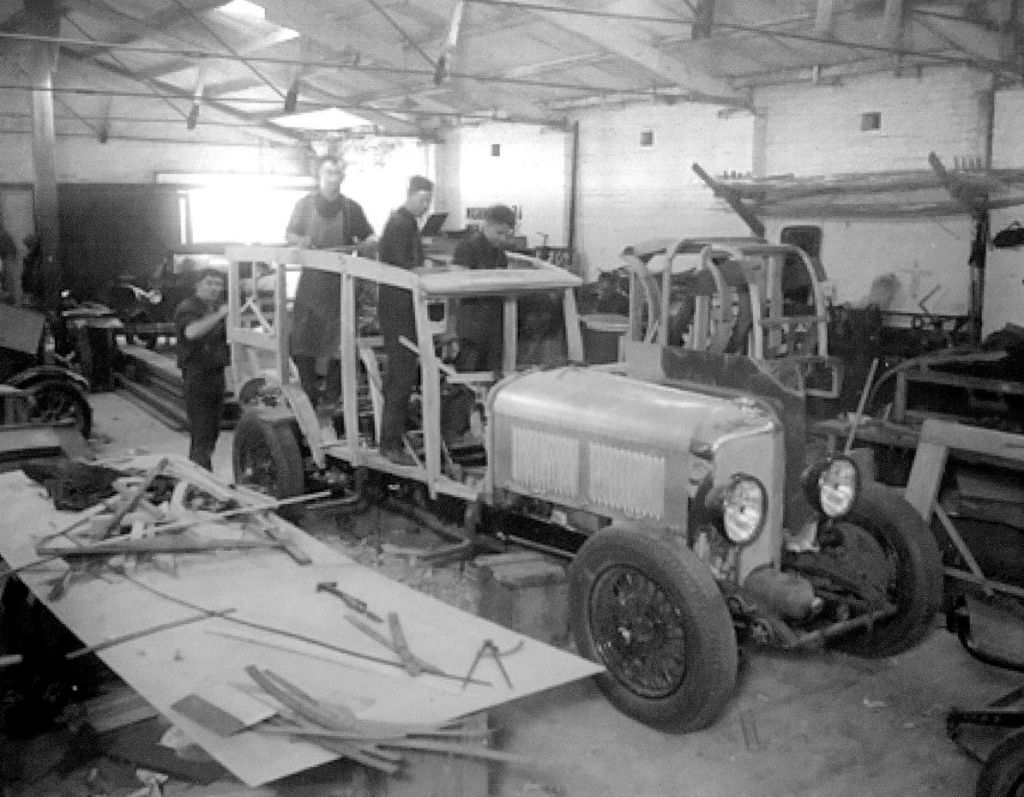
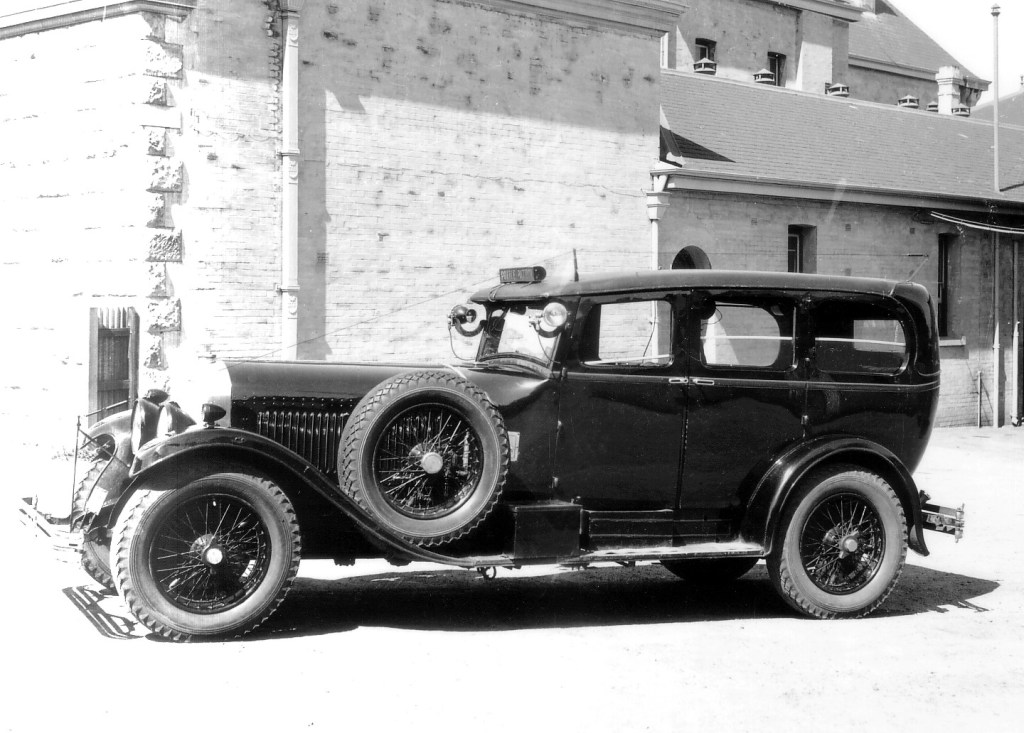
Just as well also, because the Bentleys were fitted with heavy bodies. Bryans Motor Body Works, a small operation in Perth constructed the two bodies exactly the same, using sturdy jarrah for the body frames, and aluminium for the panels. The cars finished up with rather American style bodies, which had been specified to be particularly strong, given that the intended use of the Bentleys would be very demanding.
They began in service in October 1930.
Even with a full crew, the two-way radio and other police equipment and the heavy bodies, the Bentleys were able to perform well. Even after some years of use, in 1935 the Police News noted that one of the cars had been timed at 92mph.
In his 1931-32 report the Police Commissioner stood by the Bentleys, stating “There is no doubt the efficiency of the Department has been considerably increased by the fact that a mobile police station can now be communicated with a moment’s notice.” There was also a detailed analysis of the per-mile cost of all Police vehicles, with the new Bentleys costing less to run than a 1913 Talbot still on the fleet.
It was all good justification for the huge sum of money which had been invested in these cars – however it was not all smooth sailing for the Bentleys.
The two-way radios were not the best performing units imaginable. The cars were largely used for night patrol – between the hours of 9pm and 5am. Perth Central Station was not ideally situated to receive communications from the west or south of the city, so one car was kept on the high ground of Kings Park adjacent to the city centre and acted as a relay for messages for the other car as it roamed the streets. Various antenna setups were tried on the cars.
A crew of four were used in each Bentley – a driver, a radio operator, a sergeant and a ‘runner’ who sat next to the driver ready to leap out and chase after any miscreants on foot. The cars were fitted with sturdy leather straps bolted to the floor in the cabin. One policeman who was in a Bentley crew recalled years later that holding on to the straps was critical when the cars were at speed, otherwise passengers would be thrown about or hit their heads on the roof. The lucky radio operator could be strapped in place.
If the radio system left something to be desired, then the sheer performance of the Bentleys proved their worth many times. The Police claimed the cars were capable of a top speed of 114mph, and one was said to average 96mph on a journey to a house fire in an outlying suburb. These were exaggerated claims – but if ever a car was going to have urban myths develop while it was in use, it would be one of these Bentleys.
The Bentleys were christened “Gently” and “Softly”, though they were well known for their noise as the cars roared around Perth streets. Perhaps Gently from Gently Bentley and Softly to conform… The cars were also sometimes sent to remote rural areas for major crimes, where radio contact proved invaluable.
During World War Two one of the cars was fitted with a gas converter. It produced less than 7 miles per gallon in that configuration and became the car left in Kings Park to transmit messages.
By the late 1930s the radio equipment had been removed. The cars were well known around Perth and in 1947 The West Australian newspaper noted “There has hardly been a major crime committed in this State which has not been affected by one or other of the Bentleys.”
After the war was over, rationing continued and the Police Department decided it was time to sell off their well-worn, seventeen year-old Bentleys. In 1947 the cars were advertised on the Government Tender Board, incorrectly listed as Bentley 4½ litre cars.
Arthur Vance had always thought the Police Bentleys were wonderful cars and when saw them listed on the Tender Board, successfully bid £450 for the pair of cars in January 1948. Unable to afford both and only really wanting one car, Vance had arranged with an acquaintance, Ron Grey to take one car for £200. For his extra £50 Vance had the choice of car and the considerable quantity of spare parts. He chose the car which had not been converted to a gas producer.
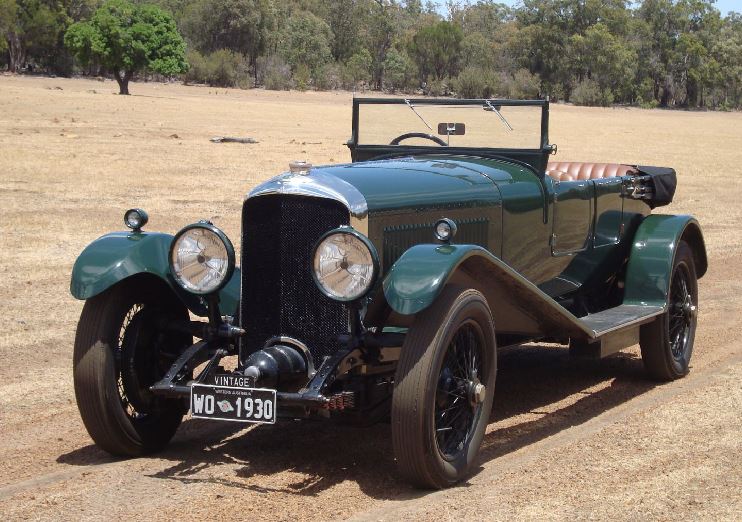
Grey proceeded to use his car covering 40,000 miles until in 1962, having covered 300,000 miles it was involved in an accident and the body was scrapped. The car was sold to a Victorian collector after which it changed hands a couple more times, ending up with Graham Miller who has owned it for many years. It wears a fabric-covered touring body which was constructed in England.
The car Vance bought, had covered 143,000 miles. Like its sister car, the Bentley was put to work, its 150bhp pulling power being quite useful for lugging. The bodywork was quite poor, having deteriorated with seventeen years of hard work often on rough roads, and Vance’s use of it as a delivery truck didn’t help.
By the late 1940s the failure of the differential pinion bearings meant that Vance put the car off the road. Vance removed the Bentley’s body in preparation for a full rebuild of the car – and buried the body in a back yard…
Although this was intended to be a short term project, subsequent industrial accidents meant that Vance did not touch the dismantled car for 25 years. In 1977 Vance came to a sharing agreement with Jim Runciman to rebuild the Bentley. In the intervening years Vance had resisted many offers to sell, remaining keen for the car to stay in Western Australia.
The dismantled car was shipped to Victoria where much of the work was done by specialists.
A new open tourer style body was built, wearing aluminium panels. The bonnet is still the original item. There were many details to attend to – instruments were rebuilt, windscreen pillars and other small items were cast, hinges and door catches and other items were sourced. Jim Runciman recalls “The engine was rebuilt and in October 1987 it fired up for the first time. Although the car was far from drivable this was a momentous occasion as the car seemed to come alive.”
A couple of the ‘old boys’ from the police force who’d used the Bentleys visited Runciman to see the car in the 1980s “One had tears in his eyes” recalls Runciman.
After many years of work, the Bentley was finally finished and in 1996, 48 years after it was last driven, the Police Bentley was back on Perth roads.
Vance has since passed away and the car is now wholly Runciman’s – the second private owner of a car over eighty years old. It has been used extensively, having been rallied in many parts of Australia and taken to South Africa for two rallies. The car has been in parade laps at the Australian Grand Prix in Melbourne and has competed in the Phillip Island Historics as well as the Classic Rally in Western Australia.
“When we attended the VSCC Silver Jubilee Rally in Victoria, by chance I decided to look at the chassis numbers of the three Speed Sixes that were there – and they all had successive chassis numbers.” Runciman says.
Runciman has done over 20,000 miles in the car, one of which was a trip in 2002 to Uluru (formerly known as Ayers Rock) in central Australia, along with three other Speed Sixes. So nobody could say this car has been pampered – ever.
“It’s a great cruising car,” Runciman enthuses, “on a moderately winding road it’s capable of 85-90mph and even after 4 or 5 hours is still comfortable. But it’s a pig to drive in city traffic because of the heavy steering and crash gearbox – it gives a wonderful insight into motoring of that era”.
In some ways it’s a shame that the original Police bodywork is no longer there, but in 1949 it was really just rubbish. But it’s wonderful that these cars still exist and they are testament to the amazing decision to order the Police Bentleys made over 80 years ago.
In a letter from Vance, published in Motor Sport in May 1949, he noted “When we took delivery of the cars from the plant engineer’s workshop, the parting was too much for the mechanic who assembled them and had ‘nursed’ them through their long and chequered career, such is the mark these grand old cars leave on one.”






 Paul Blank