
Text and photos by Paul Blank
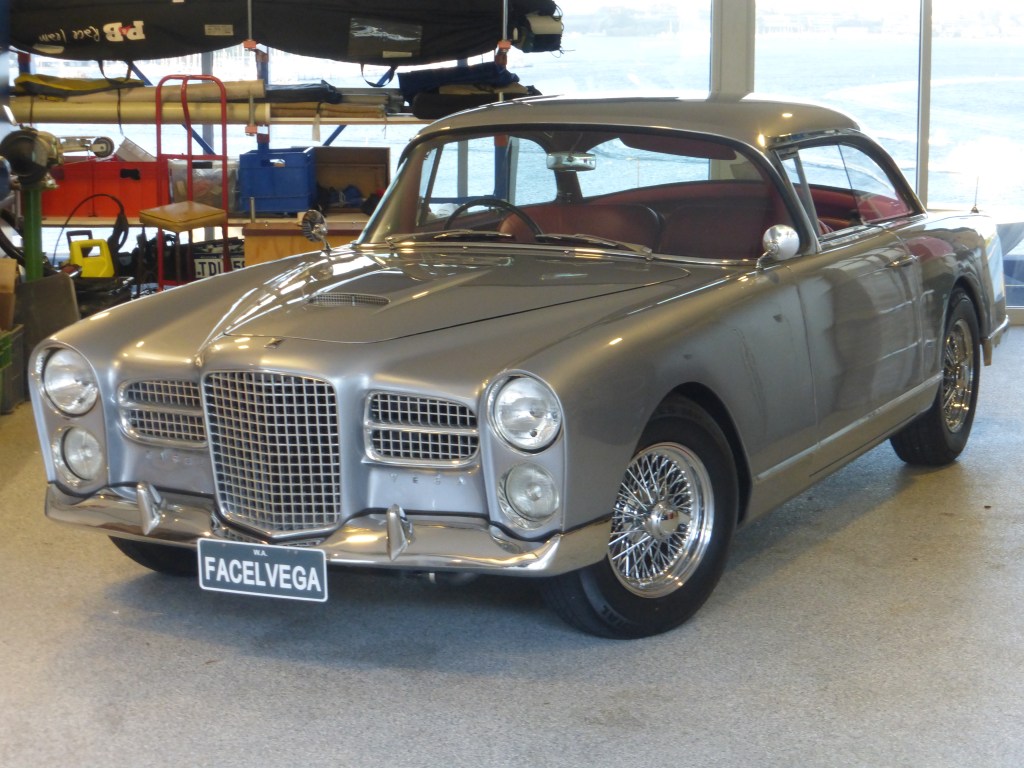
Facel Vega was a prestigious marque which flourished for just ten years. It was the product of a Paris-based company which had specialised in steel and stainless steel products. His company expanded to production of sporting versions for Simca and Ford, designed by Facel.
Jean Daninos, the company owner, bemoaned the fact that no French car maker produced exclusive vehicles. Great marques such as Bugatti, Delahaye and Delage had not survived for long after World War Two and registration costs of large-engined cars were prohibitive in France. His first efforts at extremely upmarket cars were based on Bentley chassis, of which just a handful were made.
By 1954 he had announced the Facel Vega, an exotic looking grand touring car boasting an American Chrysler V8 engine. Expensive, exclusive and stylish, the cars were a success from the start. Exports were strong and the cars appealed to the glitterati.
Over the next few years the model was developed further, with bigger engines and refined styling, becoming the HK500 in 1959, sporting a 6.3-litre V8 engine with 360 horsepower – and providing huge performance.
By now the Facel Vega was as fast as a Ferrari, and as expensive as a Rolls-Royce.

It was a very luxurious car for the late 1950s – with power steering, electric windows and leather seats. In that era a Rolls-Royce still had manual windows… Disc brakes and either a Pont-a-Mousson manual gearbox or Chrysler Torqueflite automatic transmission could be specified. Wire wheels were a popular option.
The company’s experience with stainless steel saw them use the material for bumpers, window surrounds and other brightwork on their stylish cars.
The Facel Vega became a must-have for the influential and wealthy people and attracted many big name owners, including Tony Curtis, Frank Sinatra, Ringo Starr, Joan Collins, Dean Martin, Danny Kay, Ava Gardner, Joan Fontaine, and many Barons, Counts, Lords, Princes, captains of industry and other very well-to-do buyers.
Famously, Stirling Moss was among several racing drivers to take delivery of Facel Vegas. The first time I met Sir Stirling, I asked him his recollections of the Facel. He told me that he used to change cars quite frequently, but kept the Facel Vega for a long time “because it was perfect for driving between races anywhere on the Continent”. A better recommendation would be unlikely.
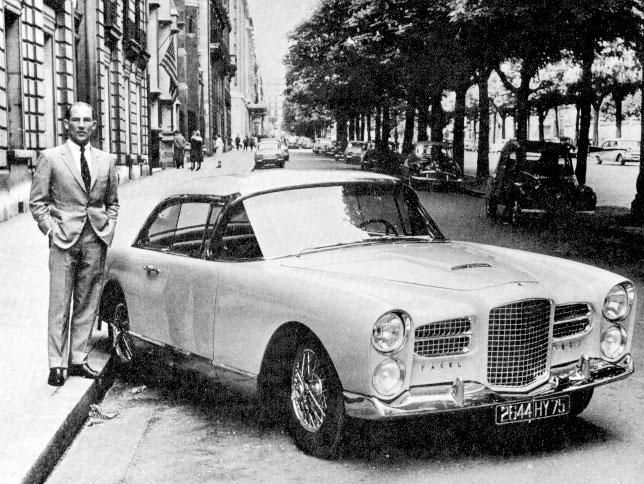
In ten years of production, Facel Vega produced an interesting range of cars. Their staple product was the big V8-engined Grand Routiers, the FVS, HK500 and Facel 2 – each being a derivation of its predecessor, but with major changes along the way. Production numbers were always quite small.
The company made two cars which might be called aberrations with the benefit of hindsight. First was the Excellence – which was based on the HK500, with four doors, on a longer wheelbase and with a different rear end design. As a super luxurious, high performance sedan, it was unmatched. However, Facel made the Excellence with rear-hinged back doors and no central pillar, which was very dramatic, but did little for the structural integrity of the car.
Their next problem child was the Facellia. The decision was made to produce a smaller sports car, in much bigger quantities which would bring significant profits. The Facellia was a little larger than an MGB, though built to a higher specification and sold at a higher price point. The engine was a sweet twin-cam design, made by Pont-a-Mousson. While sales initially flourished, unfortunately the engine was not properly developed when the Facellia was launched and it caused nightmares for the company – eventually forcing it to close.
Had the company kept to its upmarket models only, it may well have survived – but specialist companies like Jensen, Aston Martin, Maserati and so many other specialists have bounced from owner to owner, from financial ruin to barely surviving, perhaps the writing was on the wall for Facel Vega anyway.

Above: I photographed this immaculate Facel ll at the International Facel Vega meeting, Sinsheim, Germany.
Below: Interior of the HK500 featured painted faux wood finish on the dashboard.


Above: The pretty Facellia brought about the demise of the company. Photographed at Automedon, Paris.

Copyright Paul Blank
 Paul Blank