
by Paul Blank
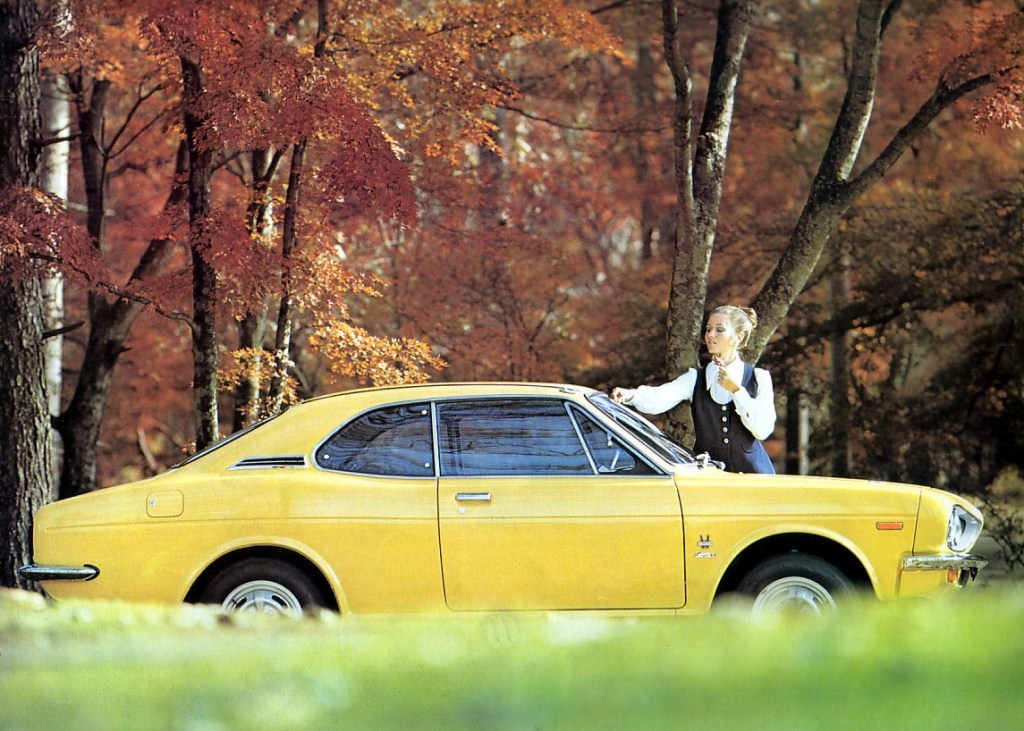
Now and then you’ll see a car from the ‘70s which rings a bell somewhere in the back of your memory. An occasional sighting of a Honda 1300 Coupe might just get some of your synapses snapping, taking you back to a time when these high-tech Japanese cars were seen on our roads.
And outside of Japan, Australia was the most likely place you’d see one.
Having achieved world domination in selling motorcycles, on entering the car market, Honda was keen to establish a wide range of cars, starting with the little S500/600/800 sports models and small commercial vehicles.
By the end of the 1960s, their cars ranged from the small Kei cars, the N360, called the Scamp in some markets, through the stylish S800 sports and Coupe to the larger 4-cylinder 1300 range of 4-door sedans.

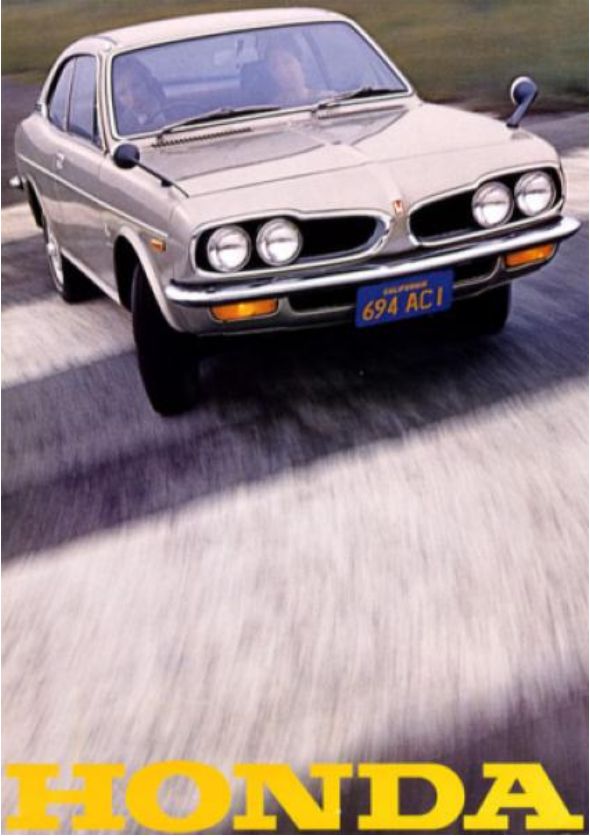
Then, derived from the 1300 sedans were the very attractive Coupe 7 and Coupe 9, as top of the range versions. The first Coupes were sold as 1970 models. Featuring sleek fastback bodywork, and distinctive split-grille front styling, these cars incorporated many of the sorts of excellent high-tech features for which Honda was famous.
The Coupes were a big step, and a big statement for Honda. They were in fact, the last model that company founder Soichiro Honda was involved with the development of. The transversely-mounted, aluminium alloy engine of the Coupe 9 featured four Keihin carburettors and a dry sump lubrication system – real racing car level of technology, which only the most exotic Italian supercars shared. The engine was also air-cooled – pretty radical for a front engined car at that time. Mr Honda’s creatrive influence was pretty clear.
Other technical features included front wheel drive, a forged steel, nitrided double-counterweighted crankshaft and chain drive from engine to gearbox, plus a side-mounted clutch – able to be changed in just 30 minutes. Standard fitment was a 4-speed gearbox, though for the Japanese market an auto was offered, and late in the model life, a 5-speed manual was optional.
Honda’s engine construction was dubbed Duo Dyna. Two fans forced air through cavities, much like a water pump would on a liquid-cooled car. One fan forced cooling air through the passages, while a second fan blew the heated air from the engine.
The 1298cc engine produced an impressive 85kW (116 bhp) at 7300rpm, or (95 bhp) in the cheaper, single carburettor Coupe 7. The high performance 9 also boasted a higher compression ratio. The Coupe 9 weighed 905kg, which seems light today but compares to 940kg for a Mk1 Celica or 966kg for a Ford Capri. Speeds achievable in the gears were 55, 93, 138 and 185km/h – very good performance for a 1300cc car in 1970. The 0-100km/h time for the 9 was 11.5 seconds and the 7 was a second slower.

Suspension was all independent, with McPherson struts up front. Steering was rack and pinion and front disc brakes were fitted. The Honda Coupes handled very well for their era, with excellent stability and handling which was greeted well by the press at the time. While they had quite a bit of bodyroll, the road-holding is still pretty good. In 1971 Wheels magazine tested the car and were very impressed, saying “We tested the Honda on the greatest variety of roads we could find and we say its suspension is one of the best-sorted of any car, regardless of size or configuration.”
Front wheel drive was still unusual back then and gave extra space in the cabin, which was probably necessary as the Coupes were claustrophobically upholstered, completely in black. The interior was certainly well decked-out, with comfortable reclining seats, comprehensive instrumentation and a stylish 3-spoke sports steering wheel.
In 1971 the Coupe 7 was listed in Australia for $2894 and the Coupe 9 for $3180. These prices compared to a Mazda R100 Coupe for $2695, a Mazda Capella RE Coupe $3333, Ford Capri Deluxe 1600 for $2775 or Capri XL $3040. In the more overtly sporty competition, a Fiat 124 Sport 1600 BC was $4250 and a Datsun 240Z would have set you back $4666.
After just two years, the models were dropped from all export markets, as the huge-selling Honda Civic was ramped up. An updated version of the Coupe, called the 145 was sold in Japan for a period.
These Hondas are virtually unknown outside Japan, except in Australia where they were sold in reasonable numbers. Very small numbers were sold in other Asia-Pacific countries. Interestingly, it’s one of the few vehicles which was never sold in New Zealand, though a few migrated as private imports. The Coupes were evaluated for the American market and even a brochure featuring a US registered car was made, but no sales were made there. Equally Europe and the UK never saw sales of these cars.
The Honda dealership network in Australia had found its legs by this period, with popular small models such as the Scamp, Life and Z all doing well. Legend has it that all of the Australian delivered 1300 Coupes were originally “S” models (with all the extras), but when they landed here, they risked attracting higher insurance fees (due to anything with an “S” or “GT” being regarded as a Sports version), so the dealers replaced all “S” badges with “Deluxe”.

They were also raced and rallied with some success by Aussie enthusiasts who appreciated their high tech specs, the cars even featuring in the Bathurst enduros. In 2008 in Victoria a 1972 Coupe 9S was offered for sale, the owner stating the car was; “Believed to be 1 of 3 built by Honda Japan for rally and race, but never raced or rallied”.
By today’s standards, the Coupes are still relatively easy to drive. There’s no power steering, but it’s only at parking speeds that you notice. The rack and pinion steering still shows eagerness to turn in well when approaching a corner. Inside, the seats feel a bit flat but the driving position is quite good – if a bit like an Italian car of the era. The steering wheel seems set quite high, possibly exacerbated by the tail-down stance the Coupes have.

You can see that car makers have learned from the black with black on black interiors that some designers thought was sporty in the 1970s.
From driving a Coupe 9 some years back I recall that if you ring the neck of the eager engine, the performance is pretty good – this of course being relative to the era of the car.
Fortunately for 1300 Coupe owners, sales figures are available; about 38,000 of the Coupes were made, with 1053 being exported, 731 of which were sent to Australia. The breakdown was: NSW 235, Victoria 176, WA 168, SA 62, QLD 51, Tasmania 33 and ACT 6.
Today, probably because of their fascinating mechanical layout, a few remain in existence in each state though their values are still relatively low. Only a handful of these survivors remain on the road today. Old age has caught up with most of these cars, most of which are in need of some love. The rarer 4-carby Coupe 9 is the much more collectable version.
Are they a significant classic or a piece of curious marginalia? Even with increasing interest in Japanese classics, I’d probably be leaning more towards the latter…
Copyright Paul Blank
 Paul Blank